Where Should Global Crypto Platforms Report under CARF? Applying the Reporting Nexus Rules
CARF Reporting Nexus rules determine where global crypto platforms must report by applying nexus hierarchies, Partner Jurisdiction exemptions, Branch rules, and local requirements across multiple jurisdictions.
In our previous article, Identifying RCASPs Under CARF: Standards and Eight Common Business Models, we examined the entities subject to reporting under CARF. CARF adopts a functional approach to identifying reporting entities: any individual or Entity that, as a business, provides a service effectuating Relevant Crypto-Asset Exchange Transactions for or on behalf of customers, and participates as a counterparty, intermediary, or through making available a trading platform, may constitute a Reporting Crypto-Asset Service Provider (RCASP). We also considered the application of the rules to common crypto-related platforms, including exchanges, brokers, over-the-counter dealers, payment service providers, and custodial service providers.
Once RCASP status has been established, the compliance analysis must extend to the practical allocation of reporting obligations. For crypto platforms that are incorporated, managed, or operate across multiple jurisdictions, the same entity may have links to more than one jurisdiction. It is therefore necessary to determine the jurisdiction in which the entity must carry out the due diligence and reporting obligations under CARF. CARF does not determine the reporting jurisdiction simply by reference to the place of incorporation or the location of the group headquarters. For an Entity RCASP, this issue is generally addressed through the Reporting Nexus rules, which allocate reporting obligations by reference to connecting factors such as tax residence, place of incorporation or organisation, place of management, regular place of business, and Branches.
For ease of reference, the main terms used in the Reporting Nexus rules are set out below:
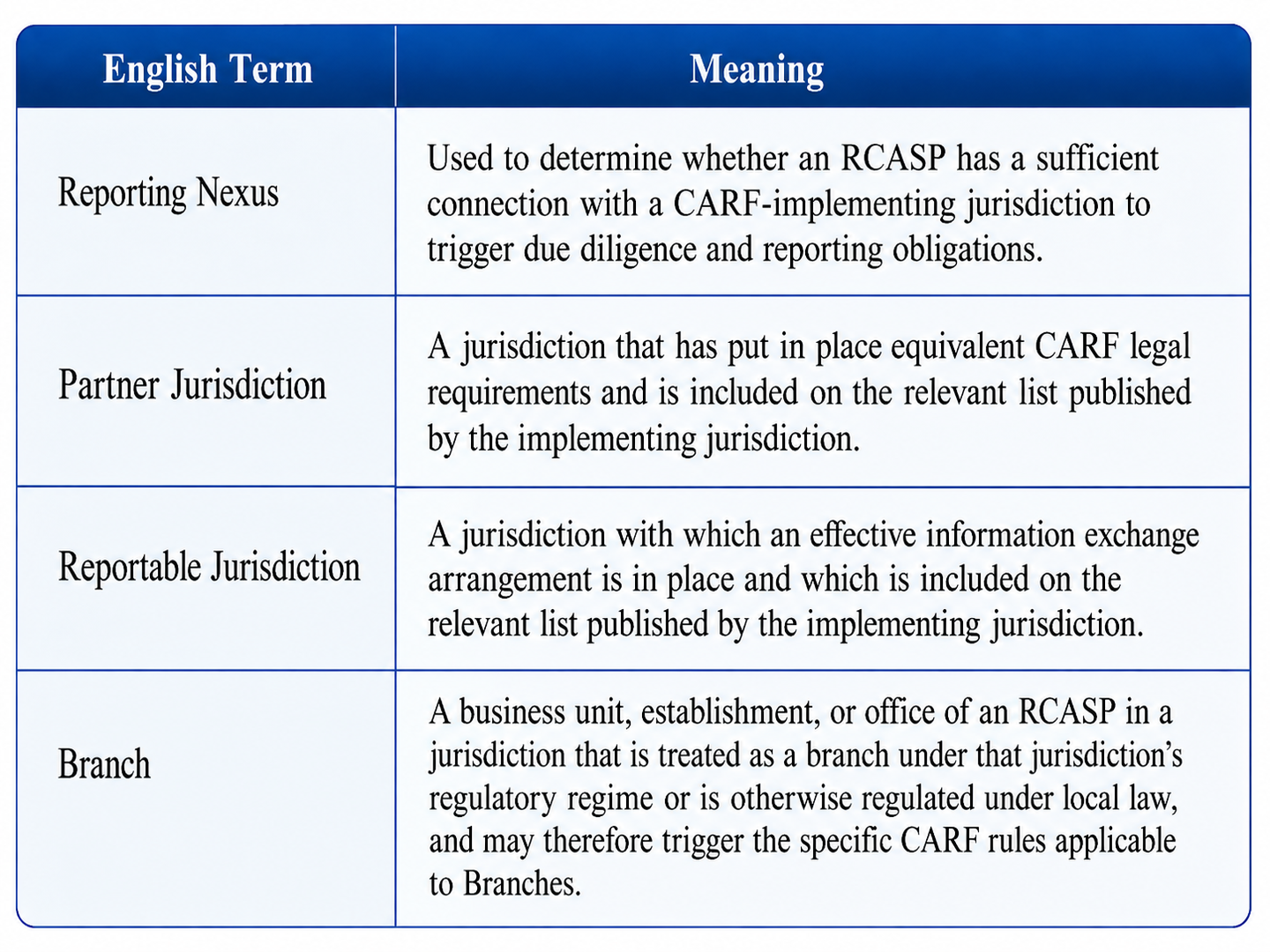
Note: Partner Jurisdiction and Reportable Jurisdiction are determined under different criteria. Partner Jurisdiction status focuses primarily on whether the relevant jurisdiction has put in place legal requirements equivalent to CARF and has been included on the implementing jurisdiction’s designated list. Its main function is to address duplicative due diligence and reporting where an RCASP has a Reporting Nexus with multiple jurisdictions, and it does not require that a CARF information exchange arrangement already be in force between the two jurisdictions. A Reportable Jurisdiction, by contrast, is directly linked to the information exchange relationship. It refers to a jurisdiction with which an effective exchange arrangement is already in place and to which the implementing jurisdiction is required to provide CARF information. This concept is primarily used to determine which tax residents are Reportable Users under CARF.
OECD Guidance
1.Nexus Hierarchy
In 2022, the OECD published the Crypto-Asset Reporting Framework and Amendments to the Common Reporting Standard. Section I—Obligations of Reporting Crypto-Asset Service Providers of the CARF Rules specifies the circumstances in which an RCASP has a reporting nexus with a CARF-implementing jurisdiction and, in paragraphs A through H, further addresses duplicative due diligence and reporting where the same RCASP has nexus with multiple jurisdictions. In 2023, the OECD formally incorporated these rules into Part I of the International Standards for Automatic Exchange of Information in Tax Matters and provided further explanation of the individual nexus criteria and their order of application in the Commentary on Section I.
In summary, Section I(A) establishes four general nexus criteria for Entity RCASPs, while Sections I(C) through I(F) establish a hierarchy among those criteria. The underlying logic is to give priority to the jurisdiction that has the stronger link to the RCASP and is therefore better placed to enforce the relevant reporting obligations.
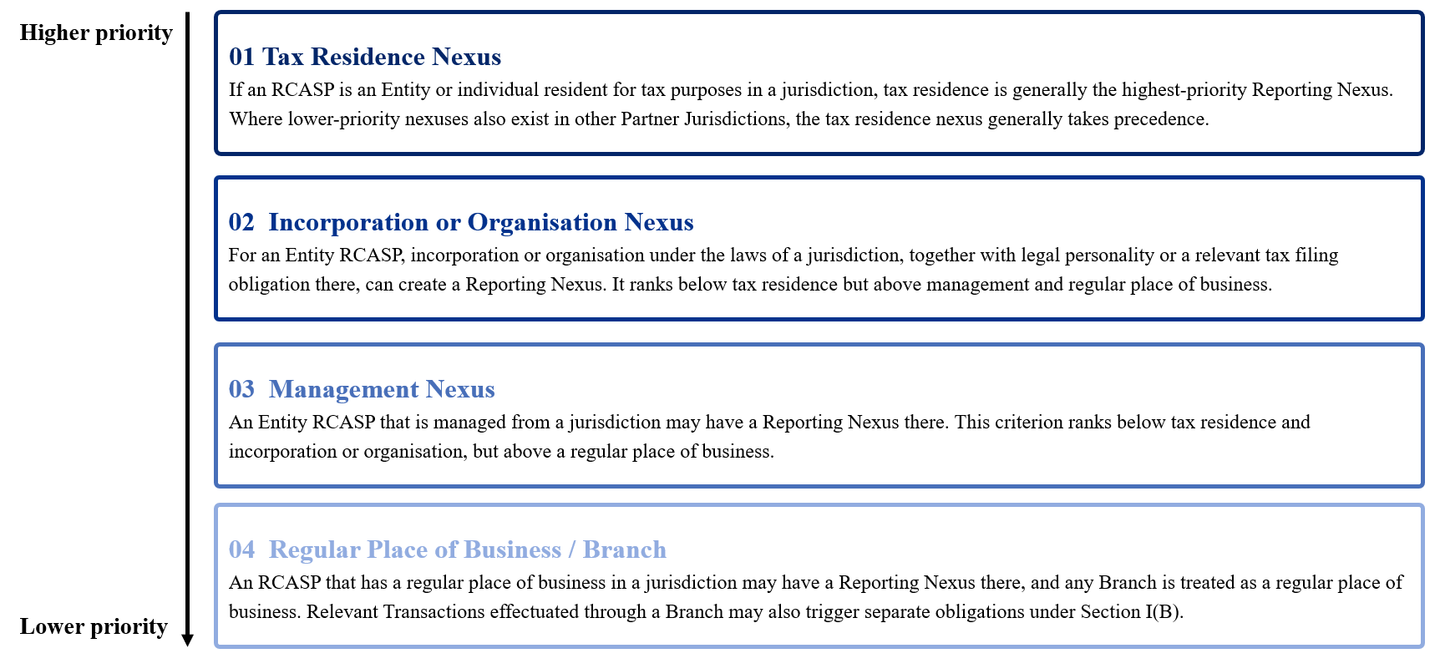
The hierarchy provides a clear framework for determining the applicable nexus. However, CARF obligations in a lower-priority jurisdiction still need to be confirmed against the local rules of that jurisdiction. The OECD’s duplicative reporting exemptions depend materially on Partner Jurisdiction status: the relevant jurisdiction must have put in place equivalent CARF legal requirements and be included on the implementing jurisdiction’s Partner Jurisdiction list, while the RCASP must also satisfy the applicable due diligence, reporting, and other conditions. If the jurisdiction in which the higher-priority nexus exists has not yet implemented CARF, or if the necessary partner relationship has not yet been established between the jurisdictions, the lower-priority jurisdiction may continue to require reporting.
2. Equal Nexuses Require a Notification
Where the same RCASP has substantially similar nexuses in two or more Partner Jurisdictions—for example, where it is tax resident in two jurisdictions—Section I(H) allows the RCASP to complete its due diligence and reporting in one of those jurisdictions and lodge a notification in the other jurisdiction, thereby reducing duplicative reporting of the same information. This rule applies only to nexuses at the same level of the hierarchy. If one jurisdiction has a higher-priority nexus, the RCASP cannot elect to substitute a lower-priority nexus.
This mechanism has been further developed in local implementation rules. The United Kingdom requires an RCASP that meets the equal-nexus conditions to make a Section I(H) election to HMRC in the prescribed manner. Singapore requires a Reporting SGCASP relying on the substantially similar nexus exemption to give an annual notification to IRAS. For businesses, the duplicative reporting exemption therefore needs to be embedded in an operational compliance process, including confirmation of Partner Jurisdiction status, retention of evidence that due diligence and reporting have been completed in the other jurisdiction, and timely submission of the required notification.
3.Rules for Branches
Branches are one of the more easily misunderstood aspects of the Reporting Nexus rules. First, Section I(A)(4) treats any Branch as a regular place of business, meaning that a Branch can itself create a general nexus between an RCASP and a jurisdiction. Second, Section I(B) provides that where Relevant Transactions are effectuated through a Branch based in a jurisdiction, the RCASP is subject to due diligence and reporting obligations in that jurisdiction with respect to the Relevant Transactions effectuated through that Branch. The triggering basis and scope of reporting under these two rules are therefore not identical.
The OECD’s FAQ, updated in 2025, clarified the first scenario. Where an RCASP’s Branch constitutes a regular place of business and creates its highest-priority CARF nexus in an implementing jurisdiction, and no higher-priority nexus exists in another CARF-implementing jurisdiction, the RCASP should complete due diligence and reporting in that jurisdiction with respect to the Relevant Transactions effectuated by the Entity as a whole, rather than only the transactions of the Branch. HMRC’s branch guidance, updated in 2026, adopts the same approach.
The OECD has also preserved transitional flexibility during the initial years of staggered implementation. Unless the implementing jurisdiction provides otherwise, where an RCASP cannot temporarily rely on the usual Partner Jurisdiction mechanism because different jurisdictions implement CARF at different times, it may, in specified circumstances, satisfy the requirements in the jurisdiction of the Branch only with respect to the Relevant Transactions effectuated through that Branch. This transitional approach further confirms that the reporting scope of a Branch must be assessed by reference to the relevant reporting year and local implementation rules. Entity-wide transactions should not be treated as the fixed reporting scope for every year and every jurisdiction.
A relatively small local Branch may, under a particular structure and in a particular implementation year, become the highest effective CARF nexus of an overseas RCASP and thereby affect the Entity-level reporting scope. When assessing a Branch, a business should therefore consider its regulatory status, the transaction functions it actually performs, whether higher-priority nexuses exist in other jurisdictions, and whether the relevant jurisdictions have established a Partner Jurisdiction relationship that can be relied upon.
Reporting Nexus Analysis for Global Platforms
In a global operating model, overlapping nexuses materially increase the complexity of the Reporting Nexus analysis.
1. Legal Incorporation, Management, and Business Functions May Be Located in Different Jurisdictions
A common global structure for a crypto platform separates legal incorporation, licensing, product development, customer operations, and transaction execution across different jurisdictions. For example, an Entity may be incorporated in an offshore centre, maintain its core management team in Singapore, operate a regulated Branch in the United Kingdom, and serve several European markets remotely. Under the CARF rules, the place of incorporation or organisation, place of management, and regular place of business may each create a nexus. Whether one of those nexuses takes priority must be determined by comparing it with the nexuses in other implementing jurisdictions, rather than by relying directly on the location of the group headquarters or the principal licence.
Remote customer acquisition should be distinguished from an Entity’s operational nexus. The OECD FAQ updated in 2025 makes clear that merely having a customer base in an implementing jurisdiction does not, by itself, constitute a regular place of business under Section I(A)(4). A user’s location may affect the population of Reportable Users or trigger regional regimes such as DAC8, but the general OECD CARF nexus analysis still requires actual connecting facts such as tax residence, organisation, management, a regular place of business, or a Branch.
The OECD Global Forum further emphasised in its 2025 CARF monitoring report that reporting nexus rules must provide effective coverage of RCASPs so that significant service providers do not fall outside the reporting network because of their place of incorporation or cross-border operating model. Each RCASP should therefore identify all jurisdictions in which a nexus may arise and then apply the hierarchy and exemptions to those jurisdictions step by step.
2. Reporting Nexus Must Be Reassessed Annually
CARF is being implemented in stages. Some jurisdictions entered the data-collection period in 2026, while others will begin implementation in 2027 or later. The OECD’s duplicative reporting exemptions depend on Partner Jurisdiction status and the actual performance of reporting obligations. A business cannot treat a jurisdiction that has merely committed to implement CARF in the future as a reporting jurisdiction that can already be relied upon for the current year. Even if the nexus structure itself does not change, reporting responsibilities may shift from one year to another as another jurisdiction begins implementation, is added to a Partner Jurisdiction list, or activates an exchange relationship.
The Reporting Nexus analysis therefore requires ongoing annual review. At least during the initial global implementation phase of CARF, businesses should reconfirm each year the effective dates in relevant jurisdictions, Partner Jurisdiction lists, exchange relationships, and local notification requirements. This annual update process is particularly important for global platforms whose operations span the 2026, 2027, and 2028 data-collection cycles.
Local Implementation Differences
Although the OECD’s four-level hierarchy is relatively straightforward, local implementation has already produced differences that need to be considered in context.
1. United Kingdom
The United Kingdom has applied CARF since 1 January 2026. HMRC has issued separate operational guidance on the nexus rules, prevention of duplicative reporting, equal nexus criteria, dual nexus and UK reporting, and Branches. As a general matter, the United Kingdom follows the OECD hierarchy to determine the primary reporting jurisdiction. Where nexuses at the same level exist in more than one jurisdiction, the RCASP may make a Section I(H) election to choose one Partner Jurisdiction in which to complete the principal due diligence and reporting obligations.
The United Kingdom also adds a domestic reporting dimension. HMRC has made clear that even where an RCASP is tax resident in both the United Kingdom and France and elects to complete CARF due diligence and reporting in France on the basis of an equal nexus, its domestic reporting obligations in respect of UK tax-resident cryptoasset users may still remain. The international duplicative reporting exemption primarily addresses duplication in cross-border CARF information exchange and does not automatically eliminate domestic reporting requirements imposed by an implementing jurisdiction.
2. Singapore
On 11 August 2026, Singapore formally enacted the CARF Regulations 2026 and published the first edition of its e-Tax Guide. The relevant rules take effect from 1 January 2027. IRAS follows the OECD nexus approach, covering tax residence, incorporation or organisation, management, a regular place of business, and Relevant Transactions effectuated through a Singapore Branch, and confirms that the general nexus criteria are applied in the OECD order of priority.
Singapore has set out relatively clear administrative requirements for the equal-level nexus exemption. A Reporting SGCASP that has fulfilled the reporting and due diligence requirements under Sections II and III of CARF under the rules of a Partner Jurisdiction pursuant to a substantially similar nexus may be exempt from duplicating the same obligations in Singapore, but it must give an annual notification to IRAS by 31 May of the immediately following year. IRAS also confirms that the person remains classified as a Reporting SGCASP and must therefore still complete CARF registration in Singapore.
3. European Union
The European Union incorporates the CARF rules into its framework for administrative cooperation in taxation through DAC8, which applies from 1 January 2026. The European Commission has made clear that relevant service providers operating in the EU without authorisation under MiCA must complete a single registration in one Member State under DAC8 and then comply with the applicable rules for reporting and exchange of information within the EU.
Irish Revenue places an RCASP that is regulated, or allowed to provide crypto-asset services under MiCA by the Central Bank of Ireland, ahead of tax residence in the nexus hierarchy. For RCASPs that are not authorised under MiCA, the criteria are then applied in sequence by reference to residence, incorporation, management, and a regular place of business. A global platform that has both an EU-licensed Entity and a non-EU CARF Entity therefore needs to map reporting entities and nexuses separately for CARF and DAC8.
Case Study: Global Trading Platform
Assume that Example operates a single brand providing crypto-asset trading services to users worldwide. Its group structure is as follows: Example SG Pte. Ltd. is responsible for the main transaction matching and account system in Asia and is tax resident in Singapore; the Entity has a regulated Branch in the United Kingdom through which some Relevant Transactions are effectuated; Example HK Ltd. is a separate legal Entity that provides exchange services directly to Hong Kong customers; and Example EU Ltd. is authorised under MiCA in Ireland and serves EU customers. Based on their respective business functions, all three legal Entities constitute RCASPs. The position of the relevant entities and Branch is as follows:
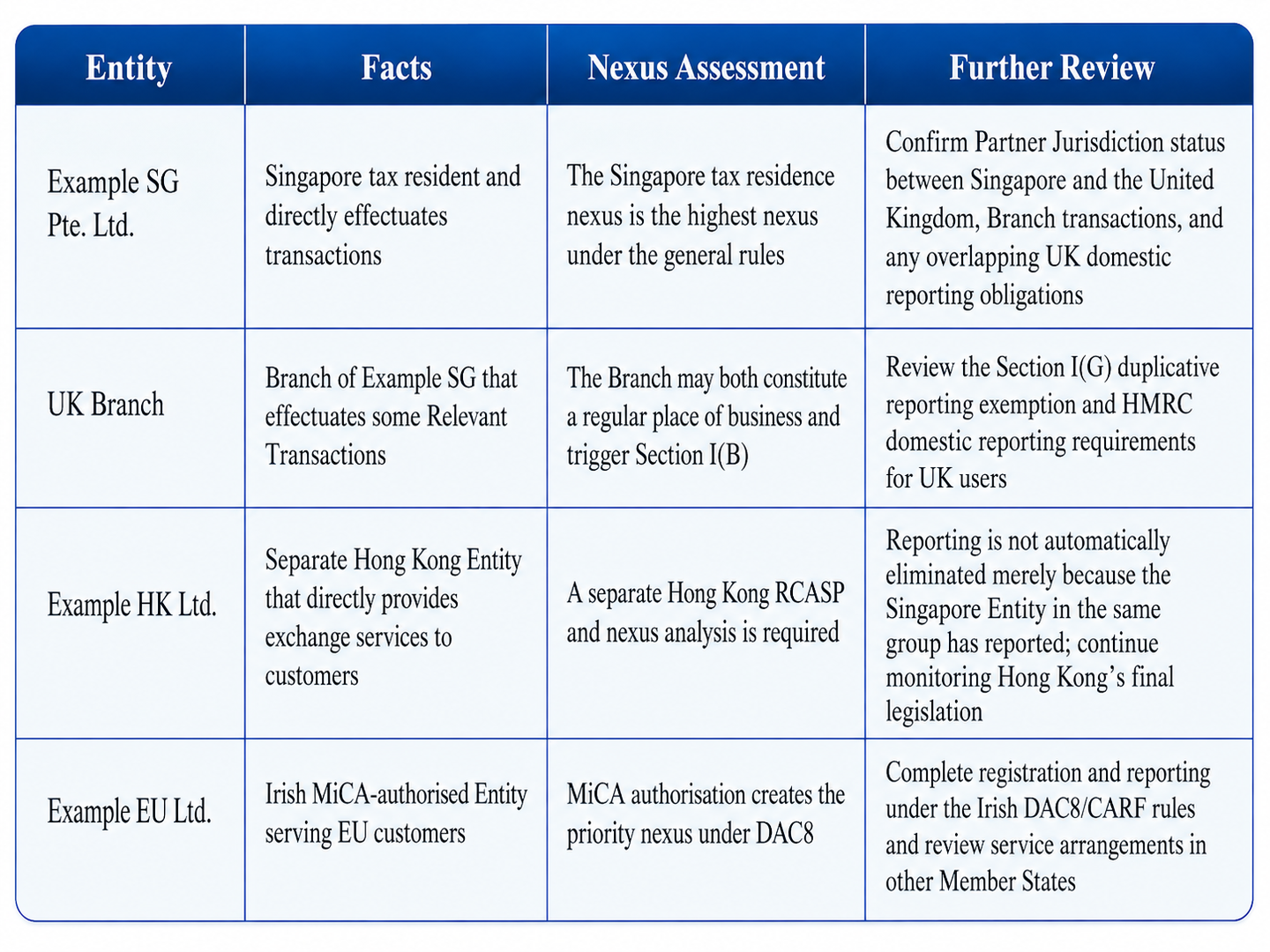
A global platform cannot resolve all CARF obligations simply by designating one group headquarters as its global CARF reporting jurisdiction. It should first identify, on a legal-entity basis, which person actually effectuates the Relevant Transactions; establish the nexus hierarchy separately for each RCASP; and then apply the Partner Jurisdiction, Branch, and equal nexus rules to address duplicative reporting. Where multiple Entities independently constitute RCASPs, the duplicative reporting rules primarily address multiple nexuses of the same RCASP and do not automatically consolidate the separate reporting obligations of related Entities.
Businesses Should Build a Reporting Nexus Map
For a globally operating trading platform, a more robust implementation approach is to incorporate Reporting Nexus into the annual CARF scope review and maintain working papers that can be traced back to the underlying business facts. The following sequence can be used:
1. Establish a legal Entity and Branch inventory. Record the place of incorporation or organisation, tax residence, licences, management team, office locations, Branches, and actual operating regions.
2. Complete a business-function mapping. Map transaction matching, brokerage, market making, OTC, payments, custody, exchange, transfer, and other functions to the persons that actually perform them, and first determine which Entities constitute RCASPs.
3. Build a nexus matrix for each RCASP. Assess tax residence, incorporation or organisation, management, regular place of business, and Branch structures separately, and retain the supporting facts and legal basis.
4. Apply the hierarchy and duplicative reporting rules. Confirm whether the jurisdiction of the higher-priority nexus is a Partner Jurisdiction, whether it has entered the relevant reporting year, and whether the exemption conditions in Sections I(C) through I(H) are satisfied.
5. Overlay local requirements. Record separately any registration, nil return, annual notification, domestic reporting, DAC8 single-registration, MiCA authorisation, and other local requirements.
6. Implement the conclusions in the data system. Ensure that each user and Relevant Transaction can be mapped to the correct RCASP, reporting jurisdiction, and reporting year, and that the final CARF return can be traced back to customer contracts, transaction records, and underlying data.
These working papers should be updated continuously as the business structure and regulatory framework evolve. New Entities, licence migrations, changes in management teams, the opening or closure of Branches, changes to the transaction-executing Entity, and updates to Partner Jurisdiction lists may all change the Reporting Nexus conclusion. For global platforms operating while CARF is still being implemented in stages, annual reassessment is therefore particularly important.
Send this FinTax note to your team.