Singapore Implements CARF: The Race for Compliance Certainty Among Asia's Crypto Hubs
Singapore’s CARF implementation sets out Reporting SGCASP classification, due diligence and reporting obligations, while highlighting regulatory certainty, Hong Kong comparisons, impacts on key crypto business models.
Introduction
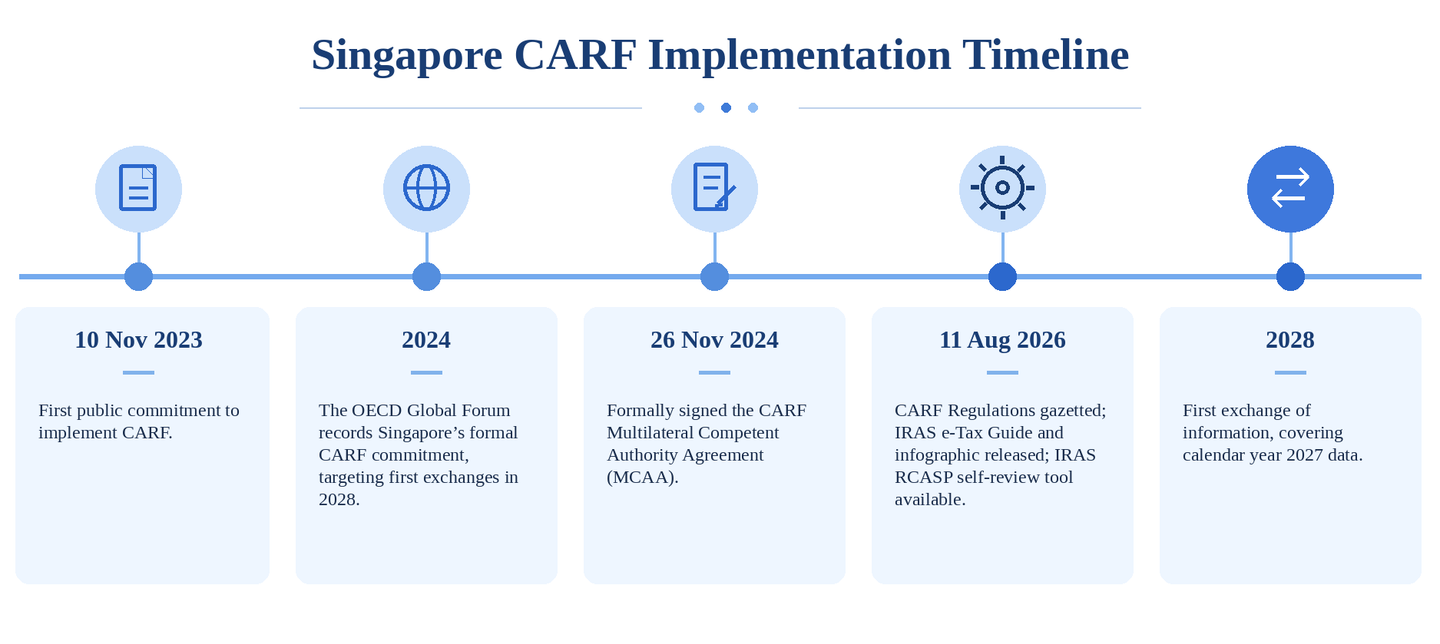
On 11 August 2026, the Singapore Government Gazette published the Income Tax (International Tax Compliance Agreements) (Crypto-Asset Reporting Framework) Regulations 2026. The Inland Revenue Authority of Singapore (IRAS) released the first edition of its CARF e-Tax Guide on the same day. The Regulations take effect from 1 January 2027, and the first exchange of information covering calendar year 2027 data is expected to take place in 2028.
As of June 2026, 76 jurisdictions worldwide had committed to implementing CARF, and the first 48 jurisdictions had required local crypto-asset service providers to begin collecting CARF data from 1 January 2026. Singapore was not the earliest jurisdiction in Asia to implement CARF domestically. Japan established a domestic CARF reporting regime through its FY2024 tax reform and, from 1 January 2026, began requiring relevant user self-certifications and other measures, with information exchanges planned to begin in 2027. Singapore, however, rolled out implementing regulations, supporting guidance and practical tools within a relatively short period, quickly forming a comparatively complete CARF implementation framework. Singapore’s decision to move CARF from an international commitment to enforceable domestic rules at this point in time, and whether this degree of regulatory certainty can create a compliance advantage, provides a useful lens through which to observe changes in competition among Asian financial centres.
1 Why Singapore Must Align with CARF
CARF stands for the Crypto-Asset Reporting Framework. The OECD completed the framework design in 2022, and it was subsequently incorporated into the International Standards for Automatic Exchange of Information in Tax Matters published in 2023. To some extent, CARF is reshaping what constitutes a favourable business environment. In the past, when crypto-friendly jurisdictions were discussed, the first association was often “light-touch regulation”. As CARF is implemented, clarity and certainty of rules are becoming new criteria for assessing a jurisdiction.
Singapore positions itself as a leading international financial centre and digital asset hub, making participation in CARF appear increasingly essential. The Monetary Authority of Singapore (MAS) has established a licensing regime for digital payment token (DPT) service providers. As a hub economy that relies heavily on international capital flows and institutional trust, non-participation in CARF would risk leaving Singapore behind in the global shift toward greater tax transparency. Conversely, joining and rapidly implementing CARF gives Singapore a first-mover advantage that is consistent with its emphasis on clear rules and institutional credibility.
Singapore’s participation has followed a clear and coherent timeline:
2 Criteria for Determining CARF Status in Singapore
2.1 Determining the Reporting Entity (Reporting SGCASP)
Before any information is reported, an entity or individual must first determine whether it is a Reporting Singaporean Crypto-Asset Service Provider (Reporting SGCASP).
This assessment involves two steps. The first is to determine whether the person, as a business, effectuates Exchange Transactions for or on behalf of customers. This determination is based on the substance of the business activities and does not depend solely on the licensing status recorded for the person.
A person that meets the above criterion constitutes a Reporting Crypto-Asset Service Provider (RCASP). The next question is whether that person has CARF reporting obligations in Singapore. The second step is therefore to determine whether the person has a statutory nexus with Singapore and consequently constitutes a Reporting SGCASP. The nexus criteria include:
- an individual or Entity resident in Singapore for a tax purpose;
- an Entity incorporated or registered under the laws of Singapore;
- an Entity managed from Singapore (i.e. its senior management decisions are usually made in Singapore);
- an individual or Entity that has a regular place of business in Singapore;
- a person that operates through a branch in Singapore.
An exemption applies to duplicative reporting. Where an RCASP has nexus with multiple CARF jurisdictions, has a higher-priority nexus criterion in another Partner Jurisdiction (for example, tax residence in that jurisdiction), and has lodged a notification with IRAS confirming that it has completed the CARF requirements under that jurisdiction’s rules, it is not required to duplicate the reporting and due diligence in Singapore.
IRAS has made an RCASP self-review tool available. Relevant persons may complete the structured questionnaire to obtain a preliminary indication of whether they fall within the scope of an RCASP and whether they have CARF obligations in Singapore.
2.2 Reportable User
Whether a user is a Reportable User must be determined by reference to the user’s tax residence and the nature of the person concerned.
- For an individual user, the principal step is to use the self-certification and other information to establish the individual’s jurisdiction(s) of tax residence and determine whether the individual is a Reportable Person.
- For an Entity user, in addition to determining whether the Entity itself is a Reportable User, its Entity classification must also be established. If the Entity is neither an Excluded Person nor an Active Entity, the Reporting SGCASP must also identify its Controlling Persons and determine whether the relevant Controlling Persons are Reportable Persons.
2.3 Core Obligations
A Reporting SGCASP is subject to the following core obligations:
(1) CARF registration with IRAS: Reporting Singaporean Crypto-Asset Service Providers that fall within scope in 2027 must complete their registration with IRAS by 31 March 2028. A service provider that first enters scope after 2027 generally must register by 31 March of the year following the calendar year in which it becomes a Reporting SGCASP.
(2) Due diligence and self-certification: When onboarding a new user, a Reporting SGCASP must obtain a valid tax self-certification and confirm its reasonableness. For Preexisting Crypto-Asset Users as of 31 December 2026, the Reporting SGCASP must obtain a valid self-certification and confirm its reasonableness by 31 December 2027. If a valid self-certification has still not been obtained and confirmed as reasonable for a Preexisting Crypto-Asset User by 31 December 2027, the Reporting SGCASP must not effectuate relevant transactions for that user from 1 January 2028 until the self-certification has been obtained and its reasonableness confirmed.
(3) Annual reporting: CARF returns must be filed by 31 May each year. The first reporting year is 2027, with a filing deadline of 31 May 2028. A service provider with no relevant reportable transactions will generally still be required to file a nil return.
The reportable information falls into two categories. The first is identifying information for Reportable Users and, for certain Entities, their Controlling Persons, including the individual’s name or Entity name, address, date of birth (for individuals), jurisdiction(s) of tax residence and Taxpayer Identification Number (TIN), among other information. The second is transactional information aggregated by type of Relevant Crypto-Asset, including the amount, number of units and number of transactions for acquisitions and disposals against Fiat Currency; the fair market value, number of units and number of transactions for crypto-to-crypto transactions; Reportable Retail Payment Transactions; and information on other Transfers in and out. A purchase of goods or services using Relevant Crypto-Assets with a value exceeding USD 50,000 is a Reportable Retail Payment Transaction.
For assets transferred to an external wallet address that is not known to be associated with a virtual asset service provider (VASP) or financial institution, the aggregate fair market value and aggregate number of units must be reported separately. The wallet address itself does not need to be submitted with the annual return, but it must be retained for record-keeping purposes.
(4) Record keeping: User identification and business relationship records are generally retained for five years after the business relationship ends. Transaction records and certain due diligence records are retained for five years from the relevant reporting year. Records relating to external wallet addresses must also be retained for at least five years.
A Reporting SGCASP may appoint a third party to assist with CARF compliance work, such as data collection, XML file generation and submission. However, ultimate responsibility for reporting remains with the Reporting SGCASP, including responsibility for the accuracy, completeness and timeliness of the data.
3 Singapore and Hong Kong Comparison: Same 2028 Exchange Target, Different Pace of Rulemaking
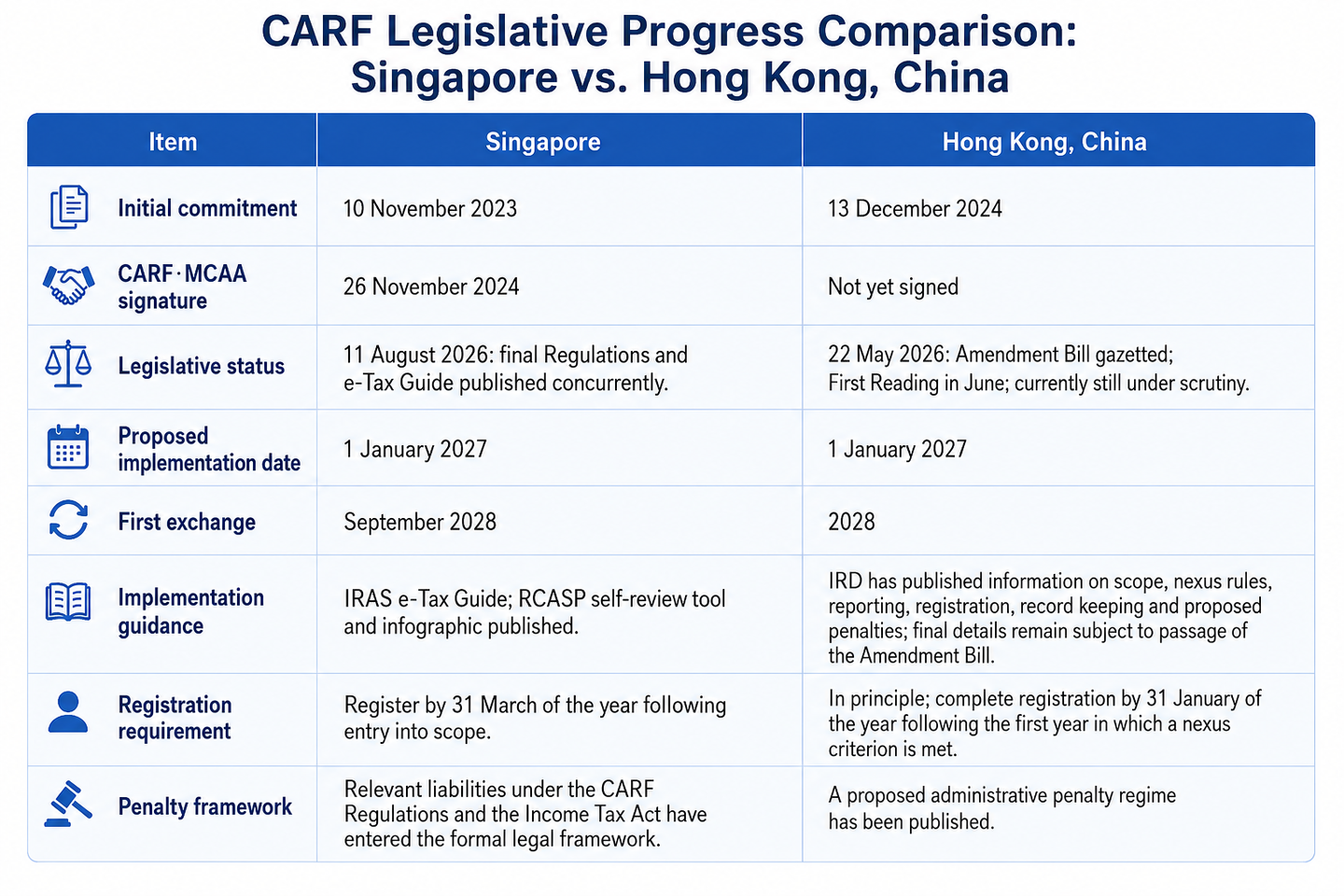
Singapore and Hong Kong, China are both important centres for cross-border finance and crypto-asset businesses in Asia. Both plan to commence their first CARF information exchanges in 2028, but the progress and degree of certainty of their domestic rules differ.
3.1 Differences in Legislative Progress
In terms of the CARF implementation timetable, Singapore and Hong Kong, China are broadly aligned, with both planning to conduct their first exchanges of information in 2028. Their domestic legislation, implementation guidance and supporting enforcement mechanisms, however, have progressed at different speeds.
3.2 Differences in Implementation Readiness for Business Location Decisions
When businesses and capital choose a financial centre, they generally consider tax burden, regulatory environment and market connectivity. Hong Kong benefits from access to the Mainland China market, a common-law legal system and relatively low tax rates, while Singapore is known for political stability, transparency of the rule of law and its position as a regional hub. Tax rates, capital-market depth, licensing thresholds, talent pools and the regulatory environment remain important components of a financial centre’s competitiveness.
As CARF is implemented, compliance certainty and institutional transparency are becoming more important. For cross-border crypto-asset platforms, whether rules are clarified in a timely manner and whether the implementation path is clear directly affects the ability to plan customer due diligence, systems changes, data governance and reporting arrangements in advance. The earlier the rules are finalised, the more effectively businesses can adjust business processes and technology architecture in a timely manner, reducing the additional cost and execution risk of repeated remediation.
Singapore’s implementation of CARF continues its longstanding policy of participating in international tax transparency cooperation and aligning with global standards. IRAS has emphasised that international tax standards must be implemented consistently and effectively across jurisdictions to maintain a level playing field and reinforce the foundation of trust in international financial centres. Singapore has allowed Reporting SGCASPs a relatively substantial lead time to adapt systems and processes, while strengthening domestic legislation and IT infrastructure and drawing on the implementation experience of early-moving jurisdictions. This has increased the stability and operational clarity of CARF implementation.
Hong Kong’s implementation of CARF must be considered in light of its dual role as an international financial centre and an important gateway for China’s external financial opening. On the one hand, Hong Kong needs to remain aligned with international tax transparency standards and respond to cross-border financial institutions and market participants seeking consistency and predictability in the rules. On the other hand, its institutional design also needs to take into account the Mainland’s current regulatory policies on crypto-assets and the financial links between the two markets. Against the background that Mainland China has not currently committed to implementing CARF, Hong Kong’s implementation places greater emphasis on coordinating international rule alignment, market openness and the local institutional environment.
4 Impact of CARF Implementation on Singapore’s Core Business Sectors
The comparison between Singapore and Hong Kong illustrates differences in policy certainty across jurisdictions. For crypto-asset businesses already operating in Singapore, however, the more immediate question is which business lines and operational processes will be affected by these rules. The degree of CARF impact varies by business model. The key issues are whether the person actually provides or effectuates relevant crypto-asset transactions for customers and whether the relevant activities fall under CARF or the amended CRS.
4.1 Trading and Payment Service Providers: CARF Becomes Part of Day-to-Day Operations
Exchanges and payment institutions are among the business types directly affected by CARF. Business substance is the basis for determining whether a person is an RCASP. If the person, as a business, effectuates crypto-asset Exchange Transactions for or on behalf of customers, it may fall within the CARF reporting scope.
For crypto exchanges, CARF compliance requirements will become part of day-to-day operations. When onboarding new users, a platform must obtain and review a valid tax self-certification, including information such as jurisdiction(s) of tax residence and Taxpayer Identification Number (TIN). For qualifying Entity users, the platform must also determine whether their Controlling Persons need to be identified. A larger workload may arise from the existing customer base. Users that already exist as of 31 December 2026 must complete the relevant self-certification and reasonableness review by 31 December 2027. For Preexisting Crypto-Asset Users that have not completed valid certification by that date, the platform generally must not continue to effectuate relevant crypto-asset transactions for them from 1 January 2028 until the certification requirements are satisfied. Platforms therefore need to modify onboarding fields and backend rules, remediate existing accounts in advance, identify information gaps, and establish mechanisms for certification reminders, exception handling and transaction restrictions. For large platforms with substantial existing customer bases, this will be a significant operational project.
Changes to transaction data systems may be even more complex. CARF requires RCASPs to aggregate different categories of transaction information by type of Relevant Crypto-Asset, including transactions against Fiat Currency, crypto-to-crypto exchanges and specified Transfers. Assets transferred to certain external wallets must also be aggregated separately. Exchanges therefore need to convert data originally used for matching, settlement and risk management into tax data that meets CARF reporting specifications and establish stable linkages among user identities, asset types and transaction records.
Whether crypto payment, remittance and merchant settlement providers fall within CARF cannot be determined by business labels alone. The key question is whether, as a business, they effectuate relevant crypto-asset Exchange Transactions for or on behalf of customers. A provider that only supplies a technical interface and does not participate in exchanges between crypto-assets and Fiat Currency or between different crypto-assets may not constitute an RCASP. If the provider actually performs exchange or matching functions within its business process, it may fall within the CARF reporting scope.
One point to note is that the CARF sets a USD 50,000 threshold for reporting retail payment transactions. This threshold applies to transactions in which Relevant Crypto-Assets are transferred in consideration for goods or services with a value exceeding that amount; it does not mean that every on-chain transfer exceeding USD 50,000 is reportable.
The CARF rules are particularly relevant to service providers handling corporate procurement, cross-border commercial payments or large-value merchant settlements. A service provider needs to map a customer’s tax residence, the exchange function and the purpose of the payment in order to determine which transactions need to be considered for inclusion in the annual report.
4.2 Crypto Funds: Generally Outside Direct CARF Scope, but Facing CRS 2.0 Pressure
Crypto funds generally do not constitute RCASPs. When a fund buys and sells assets, it is managing its own investment portfolio rather than directly providing crypto-asset exchange services to fund investors. It may, however, fall within the reporting scope of the amended CRS.
As Singapore implements CARF, it is also implementing the amended CRS. Together, the two frameworks form a transparency network for crypto-assets. CARF covers transactions conducted directly through crypto-asset service providers, while CRS 2.0 covers crypto-asset exposure held through financial institutions. Institutions that operate both traditional financial and crypto-asset businesses need to address the due diligence standards, reporting specifications and timelines under both frameworks, creating a dual operational burden for fund managers.
4.3 Family Offices
Singapore has long supported the development of fund management and family wealth management through fund tax incentive schemes such as sections 13O and 13U. In recent years, MAS has also continued to refine economic substance, governance and anti-money laundering requirements relating to single family offices, encouraging family office businesses to operate within a clearer regulatory framework.
CARF implementation does not itself change the conditions for applying the tax exemptions under sections 13O or 13U, but it will increase compliance requirements relating to customer identification, confirmation of tax residence and information reporting for family funds, family offices and related holding vehicles involved in crypto-asset transactions. At the same time, family funds and their underlying holding entities may also face Financial Institution classification issues under the amended CRS. Certain Entities that are professionally managed and primarily conduct investment activities in Financial Assets may be classified as Investment Entities and consequently become subject to CRS registration, due diligence and reporting obligations.
Conclusion
Singapore has moved CARF from an international commitment into the implementation stage and is progressively establishing an implementation framework covering entity identification, customer due diligence, data collection and annual reporting. As the relevant requirements take effect, CARF will increasingly become embedded in the day-to-day operations and systems of market participants.
For relevant institutions, the immediate priority is to determine as soon as possible whether they fall within the reporting scope and then map out Entity classifications, customer identification, Controlling Person determinations, transaction data aggregation and the boundary between CARF and the amended CRS. For platforms with large customer bases, complex business models or multiple categories of financial products, the adequacy of advance preparation will directly affect subsequent implementation costs and compliance efficiency.
Singapore’s experience also provides an important case study for observing CARF implementation in Asian financial markets. As more jurisdictions move into the implementation stage, key issues to watch will include how different markets embed CARF within their domestic regulatory systems and how the resulting differences in rules affect business operations, cross-border compliance and regional business structuring.
Send this FinTax note to your team.