Crypto Miners Pivot to AI Data Centers: U.S. State Tax Incentives and Key Considerations
A comparison of data-center tax incentives and key considerations across Texas, Virginia, and Georgia — a planning reference for crypto miners pivoting to AI data centers.
1. Crypto Mining Companies Are Pivoting to AI Data Centers
Since 2024, the combined effects of Bitcoin's halving cycle, the pullback in Bitcoin prices, and intensifying market competition have placed sustained pressure on margins in crypto mining companies' traditional businesses. A number of miners have announced pivots into data centers, seeking to redeploy their existing digital infrastructure assets into the fast-growing AI market.
This year, the shift toward data centers has moved further into execution. MARA has moved to acquire data centers and power-ready sites, acquired a controlling interest in Exaion, a subsidiary of French utility EDF, and identified digital infrastructure as a primary growth focus, with plans to progressively develop existing mining sites into AI/HPC campuses. Riot generated $23.2 million in Data Center revenue in the second quarter and signed a 20-year data center agreement with a leading frontier AI lab for 191 MW of critical IT capacity at its Rockdale campus. In February 2026, Cipher changed its name from Cipher Mining to Cipher Digital, expanding its business positioning into data center development and operations.
With mining economics under pressure, crypto mining companies must reassess the cost and return associated with every megawatt of power. Industrial land, power infrastructure and cooling systems previously used for mining may now generate more stable and attractive returns as AI demand accelerates.
Once a company decides to redeploy these assets and enter the relevant markets, a new round of capital investment begins. Tax considerations such as sales and use tax, property tax and electricity consumption tax can directly affect the investment cost of this transition.
This article uses selected U.S. states to review the current landscape and latest direction of data center tax incentives, and analyzes in depth the eligibility thresholds and implementation paths in key jurisdictions such as Texas, Virginia and Georgia, with the aim of providing a practical reference for mining companies undergoing this transition.
2. U.S. Data Center Tax Incentives: Policy Landscape and Recent Changes
Data center tax incentives in the United States are primarily established by state and local governments. In the context of crypto mining companies converting or building data centers, state-level tax incentives directly affect two major areas:
First, construction materials and equipment procurement. During a data center conversion, a mining company may need to purchase substantial quantities of tangible personal property, including servers, electrical equipment and networking equipment, to support the new business activities. These purchases may trigger sales and use tax, while some states provide exemptions if specified conditions are met.
Second, ongoing data center operations. Once a mining company's data center is completed and placed in service, land, buildings and equipment may remain subject to property tax, while high levels of electricity consumption may also be subject to sales tax, utility tax or electricity consumption tax. Accordingly, some state and local governments provide property tax relief, electricity-related tax exemptions or other economic incentives.
For many years, numerous U.S. states used tax incentives to attract data center investment. By 2026, however, public attitudes toward data center infrastructure began to shift from support toward opposition, and the policy environment changed markedly.
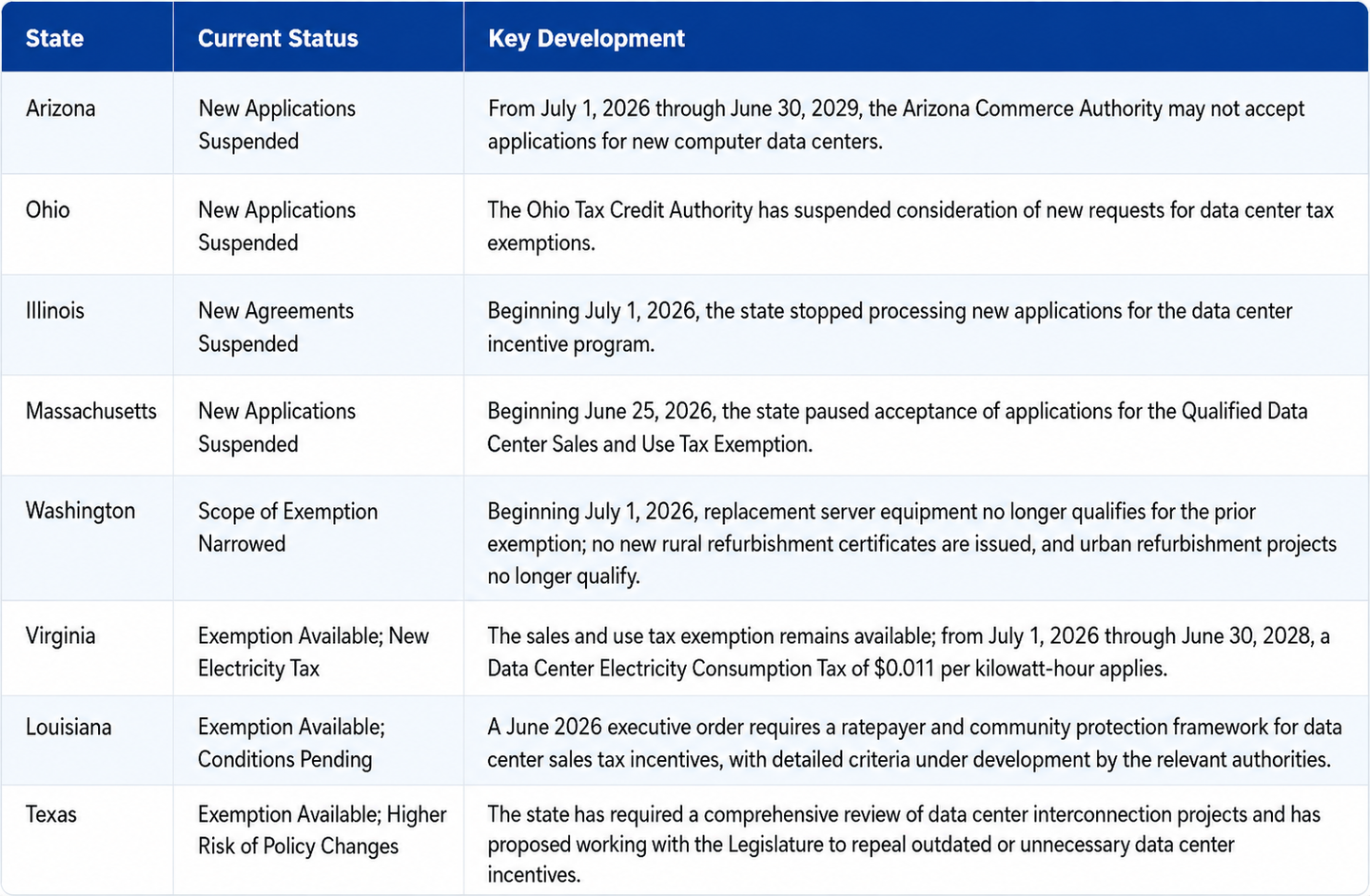
Sales and use tax incentives in major jurisdictions such as Texas, Virginia and Georgia remain available for qualifying projects. At the same time, as AI data centers expand rapidly, concerns over electricity prices, water resources and burdens on local residents have drawn broad attention, prompting several states to suspend data center incentives or consider similar measures. Beginning in summer 2026, Arizona imposed a three-year moratorium on new computer data center tax-relief applications, Washington eliminated sales and use tax benefits for replacement server equipment and refurbishment, and Louisiana raised the conditions attached to data center incentives, including requirements for data center companies to bear the full incremental power needs associated with their projects.
This means that crypto mining companies may still be able to access these tax incentives during their transition, but the availability of benefits is becoming more uncertain. Project location, whether a new exemption certification is required, the timing of the application, and new factors introduced by policy changes can all affect the actual tax cost of the transition.
Table 1. Status of Data Center Tax Incentives by State
3. State-by-State Comparison: Tax Planning for Different Project Scenarios
3.1 Texas: Temporary Sales and Use Tax Exemptions
Under Texas Tax Code §§ 151.359 and 151.3595, Texas provides temporary sales and use tax exemptions for qualifying data centers and qualifying large data center projects. A qualifying data center is exempt from the 6.25% state sales and use tax on qualifying purchases, while local sales and use tax remains due; the exemption period is 10 or 15 years. For a qualifying large data center project, qualifying purchases are exempt from both state and local sales and use tax for 20 years.
The exemption covers electricity and equipment that are necessary and essential to data center operations, including servers, data storage devices and network connectivity equipment. For electricity purchases, a predominant use study is generally required to distinguish taxable from nontaxable electricity use unless the data center or project satisfies the applicable stand-alone facility requirements.
Table 2. Eligibility Requirements
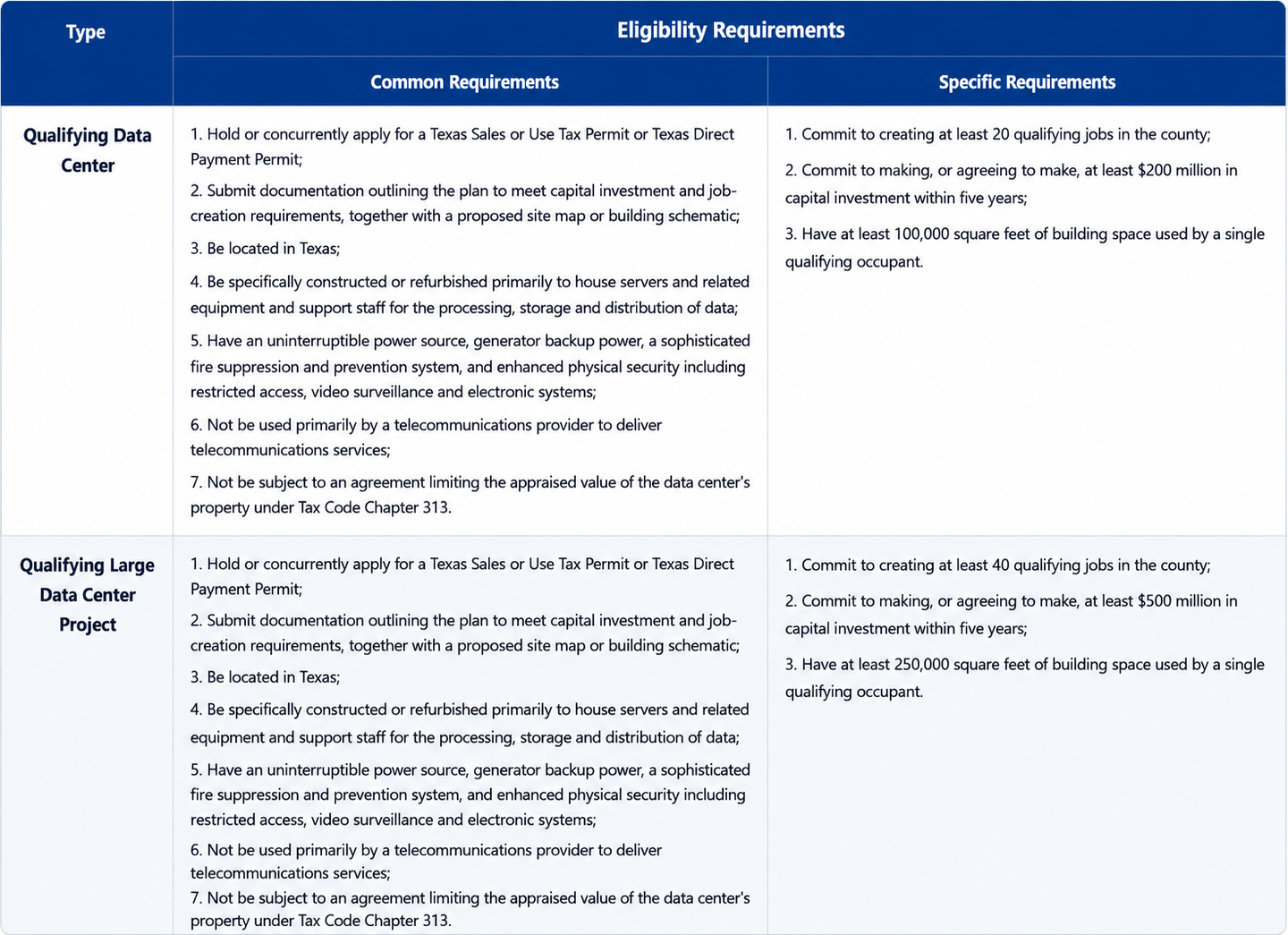
A qualifying data center eligible for the exemption must have at least 100,000 square feet of space used by a single qualifying occupant, make at least $200 million in capital investment within five years after certification, and create at least 20 qualifying jobs. For a qualifying large data center project, the thresholds increase to at least 250,000 square feet of total space, at least $500 million in capital investment within five years, and at least 40 qualifying jobs.
The implementing requirements expressly allow a data center facility to be specifically constructed or refurbished. Accordingly, the conversion of an existing mining facility is not disqualified merely because of the facility's original intended use.
To continue benefiting from the exemption, the relevant businesses must also comply with ongoing requirements, including meeting the applicable capital investment and qualifying-job commitments, submitting required reports to the Texas Comptroller, and maintaining complete records of exempt purchases until the data center's certification expires. The Comptroller reviews compliance and conducts audits; a data center that fails to satisfy the requirements may lose the exemption or have its certification revoked.
3.2 Virginia: Retail Sales and Use Tax Exemption, with an Electricity Consumption Tax
Code of Virginia § 58.1-609.3(18) provides an exemption from the Retail Sales and Use Tax for qualifying computer equipment and enabling software purchased or leased by eligible data center operators and their tenants (the DCRSUT Exemption). The exemption is currently available through June 30, 2035. If a data center satisfies specified capital investment and job-creation requirements, the exemption may be extended to 2040 or 2050 through a Memorandum of Understanding (MOU).
Qualifying computer equipment includes servers, routers and data storage equipment, and expressly covers cabling, switches, wiring and similar items used to support the operation of exempt equipment. However, general building improvements and fixtures unrelated to data processing, such as lighting and fencing, are excluded, as is fuel otherwise subject to retail sales and use tax that is used to provide electricity.
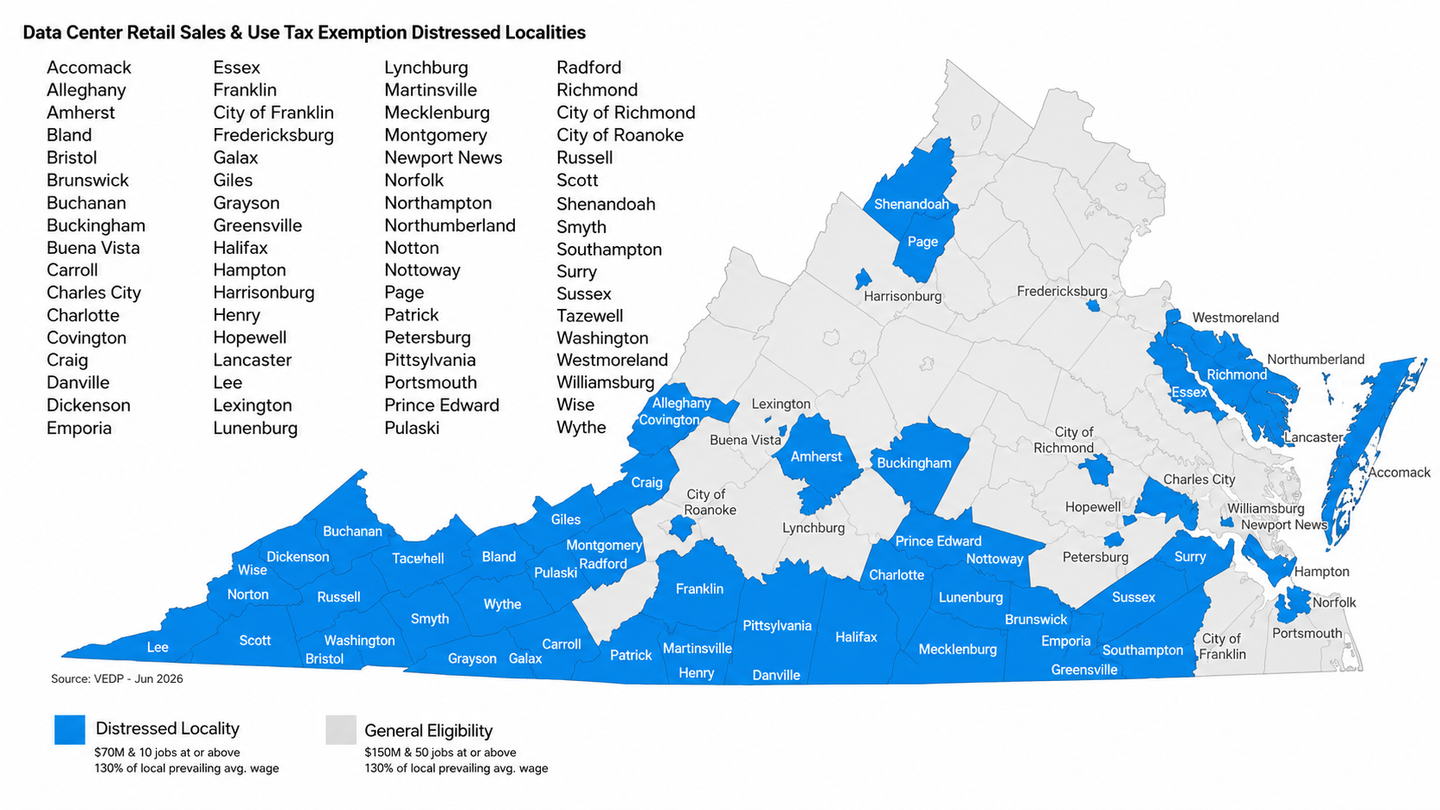
Unlike Texas, data center operators and tenants in general localities need to make at least $150 million in new capital investment. In addition, the data center must create at least 50 jobs associated with data center operations or maintenance, each paid at least 150% of the prevailing annual average wage in the locality. In distressed localities, the statutory thresholds are reduced to $70 million in capital investment and 10 operations- or maintenance-related jobs.
Figure 1. Distribution of General Localities (Gray) and Distressed Localities (Blue)
The DCRSUT Exemption carries recordkeeping and reporting requirements. Data centers and their tenants must maintain complete and accurate records of capital investment, the number of new jobs and their average annual wages, expenditures on qualifying computer equipment or enabling software, and the value of the DCRSUT Exemption. On behalf of itself and its tenants, the data center must submit annual progress reports and a final report on achievement of performance targets to the Virginia Economic Development Partnership (VEDP) and the Virginia Department of Taxation, as well as ongoing annual reports covering capital investment, total data center jobs, average annual wages, equipment expenditures and the value of the exemption.
If a data center fails to meet the minimum capital investment, job-creation or other performance targets within the prescribed period, generally three years, the relevant businesses must pay the full amount of foregone sales and use tax plus interest.
Beginning July 1, 2026, Virginia implemented a new Data Center Electricity Consumption Tax. For a two-year period, data centers located in the Commonwealth are subject to a tax of $0.011 per kilowatt-hour of electricity consumed.
3.3 Georgia: State and Local Sales and Use Tax Exemption
Under Ga. Comp. R. & Regs. r. 560-12-2-.117, purchases and uses of qualifying High-Technology Data Center Equipment by a High-Technology Data Center and its customers are exempt from state and local sales and use tax.
In addition to the owner of a High-Technology Data Center, the exemption is available to a High-Technology Data Center Customer, meaning a client, tenant, licensee or end user that is party to a qualifying contract with the Data Center Owner.
The exemption covers computer equipment and materials, software, hardware or equipment used to create, manage or maintain the data center environment, including emergency backup generators, power distribution units and routers. Real Property and electricity used in the ordinary course of operations are not included in the exemption.
The main conditions include the following: the equipment for which the exemption is claimed must be incorporated into or used in the relevant High-Technology Data Center; and the purchaser must be a Data Center Owner or High-Technology Data Center Customer holding a certificate of exemption. A Data Center Owner applying for a certificate of exemption is not subject to a minimum floor-area requirement, but must still meet the applicable Minimum Investment Threshold and New Quality Jobs requirements. A High-Technology Data Center Customer's eligibility depends on the validity of the owner's exemption certificate and the contractual relationship between the parties.
Table 3. Requirements for Data Center Owners Applying for an Exemption Certificate During the Investment Period (for Applications on or after May 9, 2022)
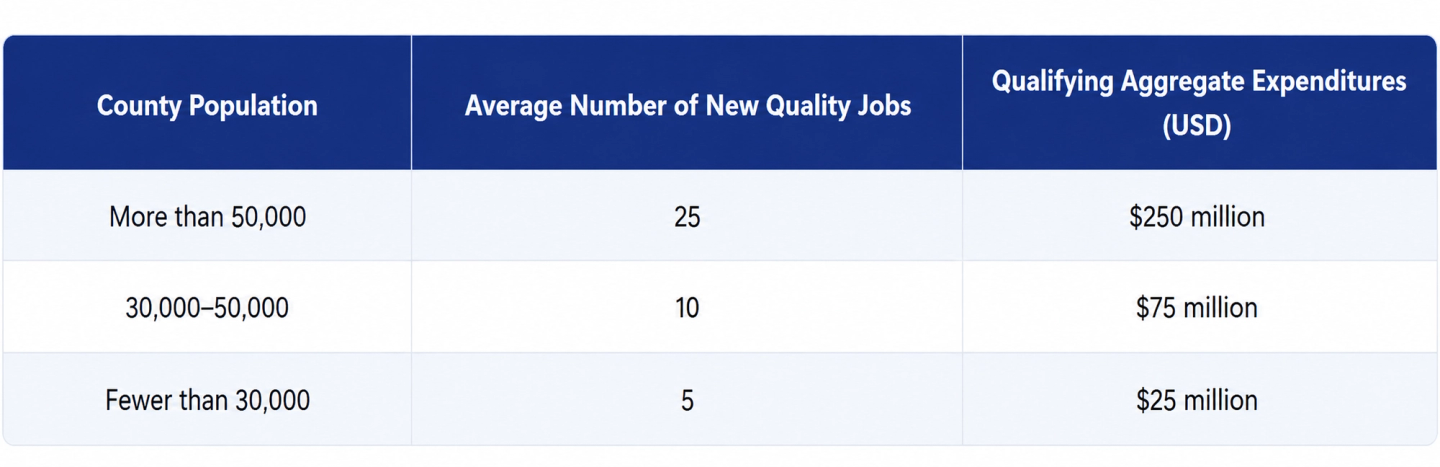
Correspondingly, while benefiting from the exemption, a High-Technology Data Center Owner must also comply with statutory annual reporting, recordkeeping and other requirements.
3.4 Tax Planning Approaches
Tax incentives vary across jurisdictions in their eligibility thresholds, scope of exemption, effective period and application procedures. Mining companies therefore need to assess the tax treatment and its impact in light of the specific facts of each project. The following examples illustrate projects with different characteristics:
Mining Company A plans to invest in or retrofit a large data center with more than $500 million in investment and more than 250,000 square feet of building space. If located in Texas, the project may qualify as a qualifying large data center project, allowing qualifying purchases of equipment and electricity to be exempt from both state and local sales and use tax. The 20-year exemption period and inclusion of electricity purchases within the exemption give Texas a clear advantage for long-term project operations.
Mining Company B plans to convert a mining site in a low-population county, with an investment of less than $200 million and limited job creation. If located in a low-population county in Georgia, the project may qualify for the tax incentive by meeting thresholds of only $25 million in investment and five New Quality Jobs. This approach allows the project to secure tax relief based on its own characteristics, but it also faces disadvantages, including the lack of an electricity exemption and a shorter exemption window. If equipment purchases are delayed, the remaining incentive window will shorten accordingly.
Mining Company C plans to retain the campus and power infrastructure while multiple tenants separately purchase servers and networking equipment. If located in Virginia, the state's framework allows tenants to enter the exemption program through a participation arrangement, supporting a more flexible commercial structure. If the project is located in a distressed locality, the $70 million investment threshold and 10-job requirement may also be attractive. However, the concurrent electricity consumption tax may reduce the benefit of the equipment exemption.
For mining companies in transition, the future duration of the exemption period, whether electricity consumption receives preferential tax treatment, whether tenants are covered by the exemption, whether the project satisfies the applicable eligibility thresholds, and whether the jurisdiction has suspended or is preparing to suspend new exemption applications are all important factors in an overall tax planning analysis.
4. How to Apply for Data Center Tax Incentives
Texas
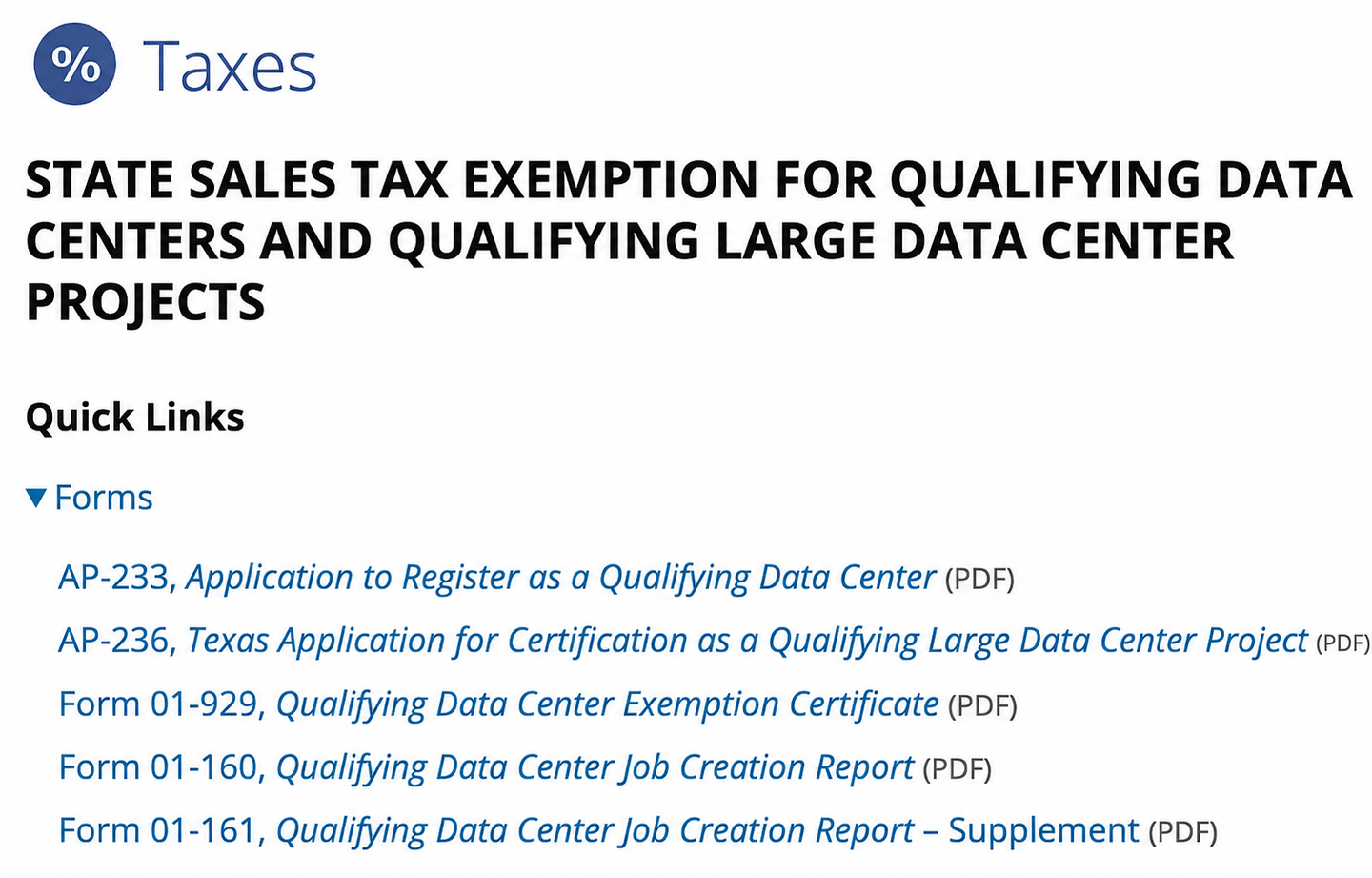
Applicants must submit Form AP-233 or AP-236 to the Texas Comptroller of Public Accounts to register as a qualifying data center or qualifying large data center project and obtain a unique registration number. They must then provide the seller with an exemption certificate (Form 01-929) to claim the exemption.
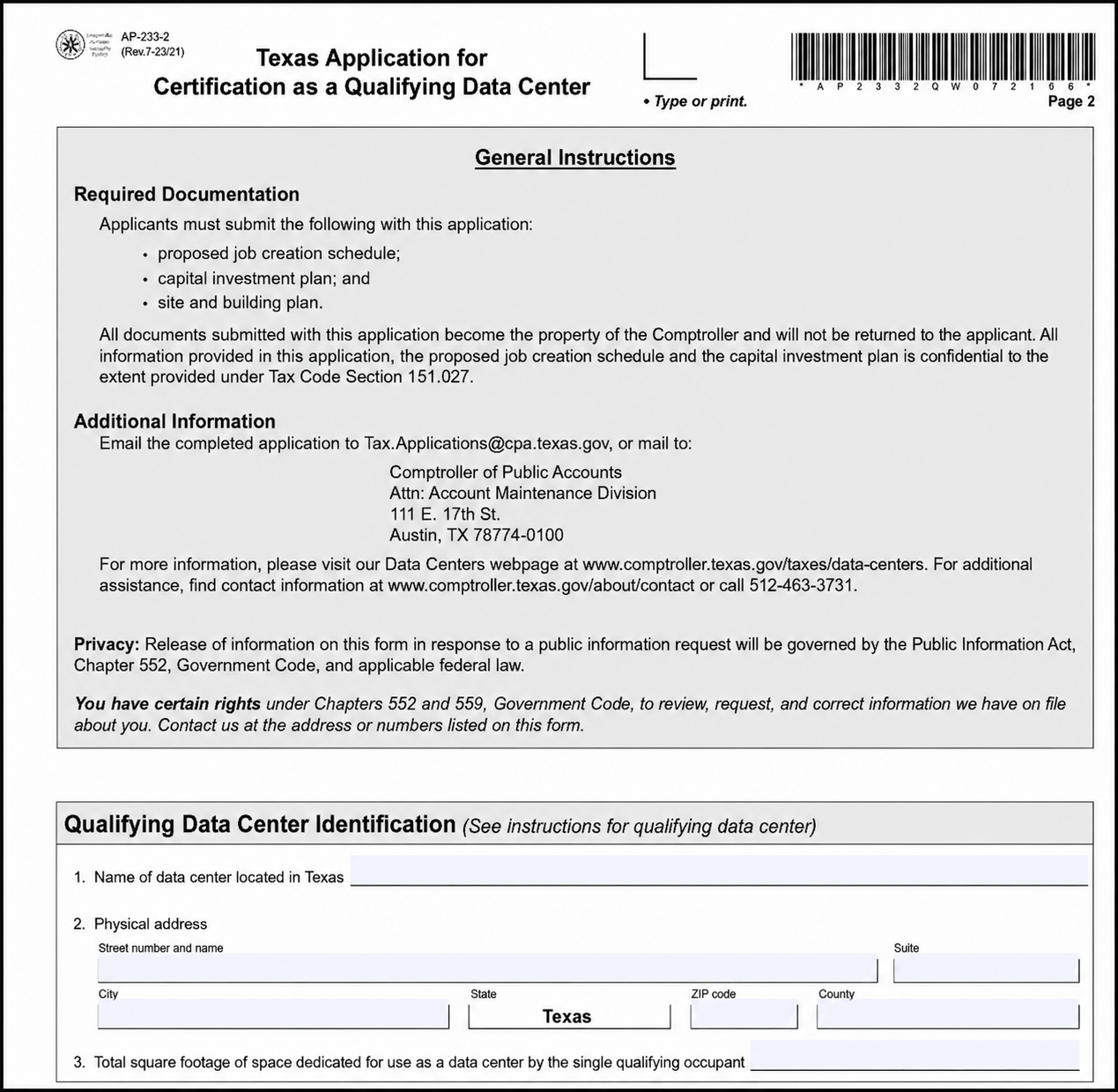
The application must be accompanied by a capital investment plan, a job-creation plan, and a site plan or building schematic.
Figures 2/3. Texas Qualifying Data Center Application Forms Download Page
Application forms:
https://comptroller.texas.gov/taxes/data-centers
Virginia
To apply for the DCRSUT Exemption, a qualifying data center must negotiate and execute a Memorandum of Understanding (MOU) with the Virginia Economic Development Partnership (VEDP). VEDP submits the MOU to the Virginia Department of Taxation for review; once approved, the Department of Taxation issues an Exemption Certificate directly to the data center.
A tenant of a colocation data center must separately enter into a Participation Certificate and Agreement with the data center. After VEDP and the Virginia Department of Taxation review the Participation Certificate and Agreement, the Department of Taxation issues a separate Exemption Certificate directly to the tenant.
MOU download:
https://www.vedp.org/incentive/data-center-retail-sales-use-tax-exemption
Georgia
A Data Center Owner or High-Technology Data Center Customer may submit an application for a certificate of exemption through the Georgia Tax Center (GTC). The Department will not issue a certificate of exemption to a customer until a certificate of exemption has been issued to the corresponding Data Center Owner.
As part of the application, a data center may be required to provide the applicant's Georgia income tax filing and payment history, the value of the applicant's title or interest in Real Property owned in the state, documentation sufficient to demonstrate the likelihood of satisfying the High-Technology Data Center Minimum Investment Threshold, and other supporting materials. A High-Technology Data Center Customer may be required to submit a copy of its data center services contract, among other documents.
Application instructions:
https://dor.georgia.gov/how-apply-high-technology-data-center-exemption
5. Conclusion
The transition of crypto mining companies into AI data centers is, in essence, a "migration of computing power." In this migration, tax policy is one of the important variables affecting project location, investment timing and business model design.
Mining companies need to consider more than which state offers the greatest incentives. They must also assess whether the project can qualify for the incentive, how long the benefit will remain available, and whether the project can continue to satisfy investment, employment, reporting and recordkeeping requirements after qualification. Filing an application too late, or making purchases before obtaining the required exemption certification, may result in the loss of tax savings that would otherwise have been available. Failure to meet performance commitments during subsequent operations may lead to repayment of tax, interest, or even loss of eligibility for the incentive.
U.S. states are currently at a subtle turning point in their approach to data centers. While some jurisdictions continue to offer substantial tax incentives, others have suspended approval of new projects or narrowed the scope of existing benefits. As policy windows contract, the "act first and apply later" approach is becoming increasingly unworkable. For crypto mining companies planning a transition, applications for tax incentives and long-term tax planning need to proceed in parallel with investment decisions.
Send this FinTax note to your team.