Digital Asset Tax Certainty Act Advances Out of Committee: What Rules Could It Add to the U.S. Digital Asset Tax Regime?
H.R. 10357 proposes targeted U.S. digital asset tax rules for fees, stablecoins, wash sales, mining, staking, classification, reporting, and voluntary disclosure within the existing property framework.
Introduction
On September 16, 2026, the U.S. House Committee on Ways and Means approved H.R. 10357, the Digital Asset Tax Certainty Act (the “Bill”), by a vote of 38–5 and reported it to the full House. The committee action came less than 24 hours after the CLARITY Act failed to advance in a key procedural vote in the Senate.
In Notice 2014-21, the IRS established that convertible virtual currency is treated as property for U.S. federal tax purposes. Sales, exchanges, and the use of digital assets to purchase goods or services are therefore generally analyzed under the tax rules applicable to property transactions. The IRS and the Treasury Department subsequently issued additional rules and guidance on issues including hard forks, staking rewards, broker information reporting, and basis. The existing framework brings most digital asset transactions within the federal tax system, but areas such as network fees, stablecoins, digital asset lending, and high-frequency trading still require rules designed for conventional property or traditional financial assets to be applied to newer transaction structures.
The Bill retains the basic tax framework under which digital assets are treated as property, while adding targeted rules for particular assets and transactions. It addresses de minimis transaction fees, stablecoins, digital asset lending, mining and staking, broker reporting, and voluntary disclosure, among other areas. Some provisions reduce the accounting burden for low-value transactions; others extend existing securities and commodities tax rules to digital assets, including anti-abuse regimes such as the wash-sale and constructive-sale rules. The Bill therefore goes beyond providing specific relief and sets out more detailed tax, accounting, and reporting treatments for different types of digital asset activity.
1 Key Changes Proposed by the Bill
1.1 Simplified Treatment of De Minimis Transaction Fees
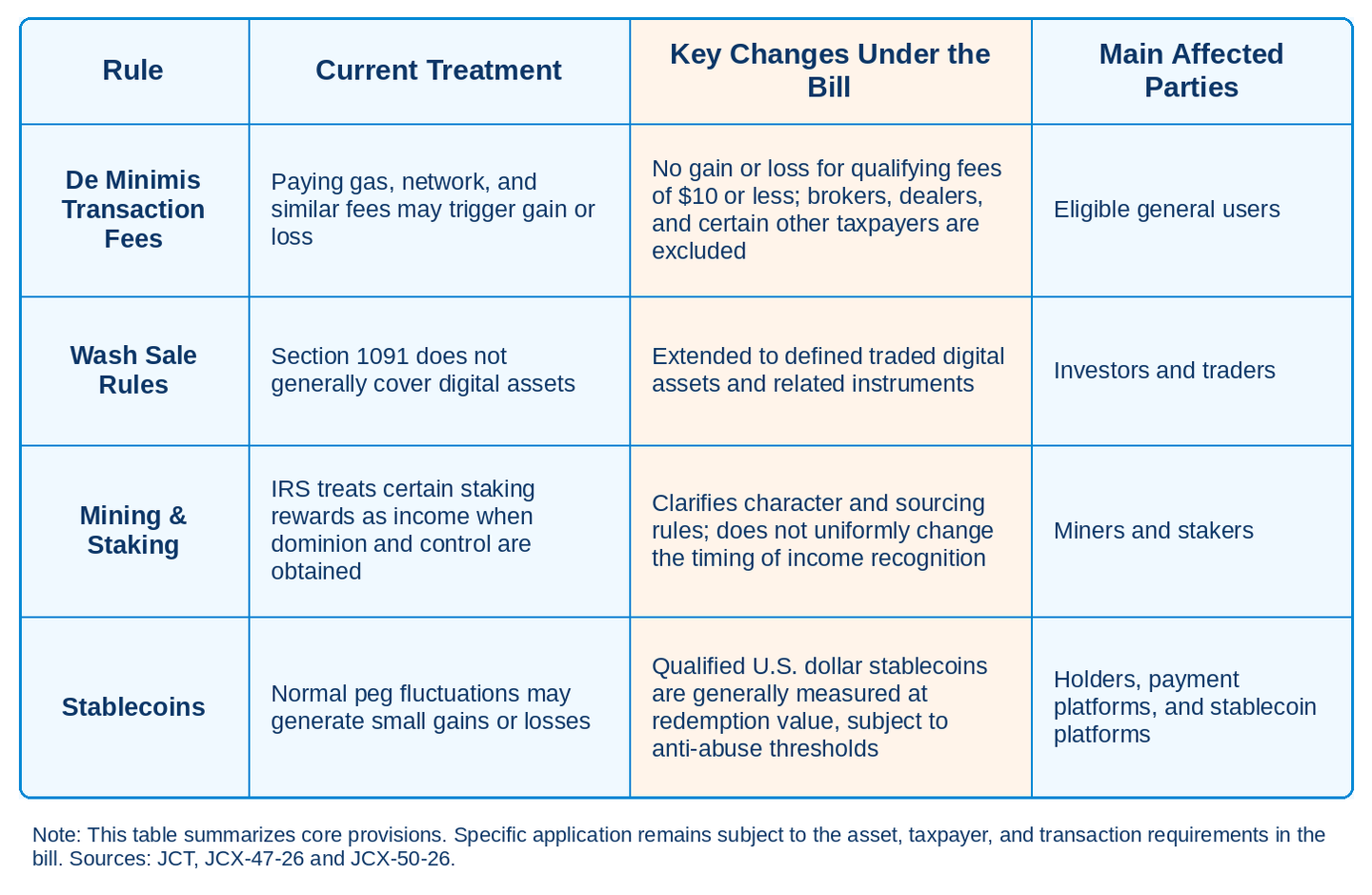
Under current law, using digital assets to pay gas fees, network fees, or other transaction fees generally constitutes a disposition of the digital asset. Even where a gas fee is only a few dollars, the taxpayer may still need to determine the basis of the digital asset used to pay the fee and calculate the resulting gain or loss.
The Bill would create a de minimis digital asset fee exception for specified low-value fees. No gain or loss would be recognized where network fees paid to validate another digital asset transaction do not exceed $10 in the aggregate, or where qualifying brokerage, trading, liquidity, or similar fees paid in the same type of digital asset in connection with an underlying digital asset transfer do not exceed $10 in the aggregate. The rule would apply to dispositions of assets after December 31, 2027.
To prevent individually small fees from producing material reporting or tax effects when aggregated across high-volume activity, the exception generally would not apply to digital asset traders, brokers, persons that in the course of a trade or business process or assist in validating digital asset transactions for others on a bulk basis, or taxpayers that entered into more than 5,000 digital asset transactions in the preceding taxable year.
1.2 Extension of Wash-Sale and Other Anti-Abuse Rules to Digital Assets
While reducing the accounting burden for certain low-value transactions, the Bill would also extend anti-abuse rules from traditional financial markets to digital assets. Section 1091 of the Internal Revenue Code, the wash-sale rule, currently applies principally to stock and securities. If a taxpayer acquires substantially identical stock or securities within the statutory 30-day window before or after a loss sale, the loss generally cannot be deducted immediately. The Joint Committee on Taxation (JCT) notes that current section 1091 does not broadly cover digital assets, and the IRS has not issued regulations or guidance generally applying the wash-sale rule to sales or dispositions of digital assets. For digital assets that are not themselves stock or securities, an investor may therefore be able to re-establish the same market exposure shortly after a loss sale while still recognizing the tax loss.
The Bill would bring defined traded digital assets and related derivatives, including contracts and options, within the wash-sale rule, while expressly excluding qualified U.S. dollar stablecoins. Whether tokenized and wrapped assets are covered depends on their economic equivalence to stock, securities, or traded digital assets. The Bill would also extend the constructive-sale rules to digital assets and modify the application of rules involving Subpart F, PFICs, straddles, and partnership distributions. These provisions are intended to reduce tax differences between digital assets and traditional financial assets that arise from differences in legal classification.
1.3 Clarifying the Tax Treatment of Mining and Staking
The Bill would further clarify that income from mining, staking, and similar digital asset validation supporting activities is ordinary income and would establish specific sourcing rules. In general, such income earned by a U.S. resident would be treated as U.S.-source income, while income earned by a nonresident would be treated as foreign-source income. Additional attribution rules would apply to qualified business units outside the United States and to U.S. offices or other fixed places of business. These sourcing rules would in turn affect analyses involving foreign tax credits and U.S. tax exposure for nonresidents.
The Bill would also provide statutory treatment for staking by qualifying investment trusts and address backup withholding for restricted digital assets. In June 2026, the Tax Clarity for Mining and Staking Act (H.R. 9175), considered at a Ways and Means Committee hearing, included an election resembling self-created property treatment that would have affected the timing of income recognition for newly created digital assets. That election was not included in the committee version of the Bill. The current Bill primarily clarifies the character and source of the income and does not impose a uniform change to the timing of recognition for mining or staking rewards.
1.4 Taxing Stablecoins by Reference to Redemption Value
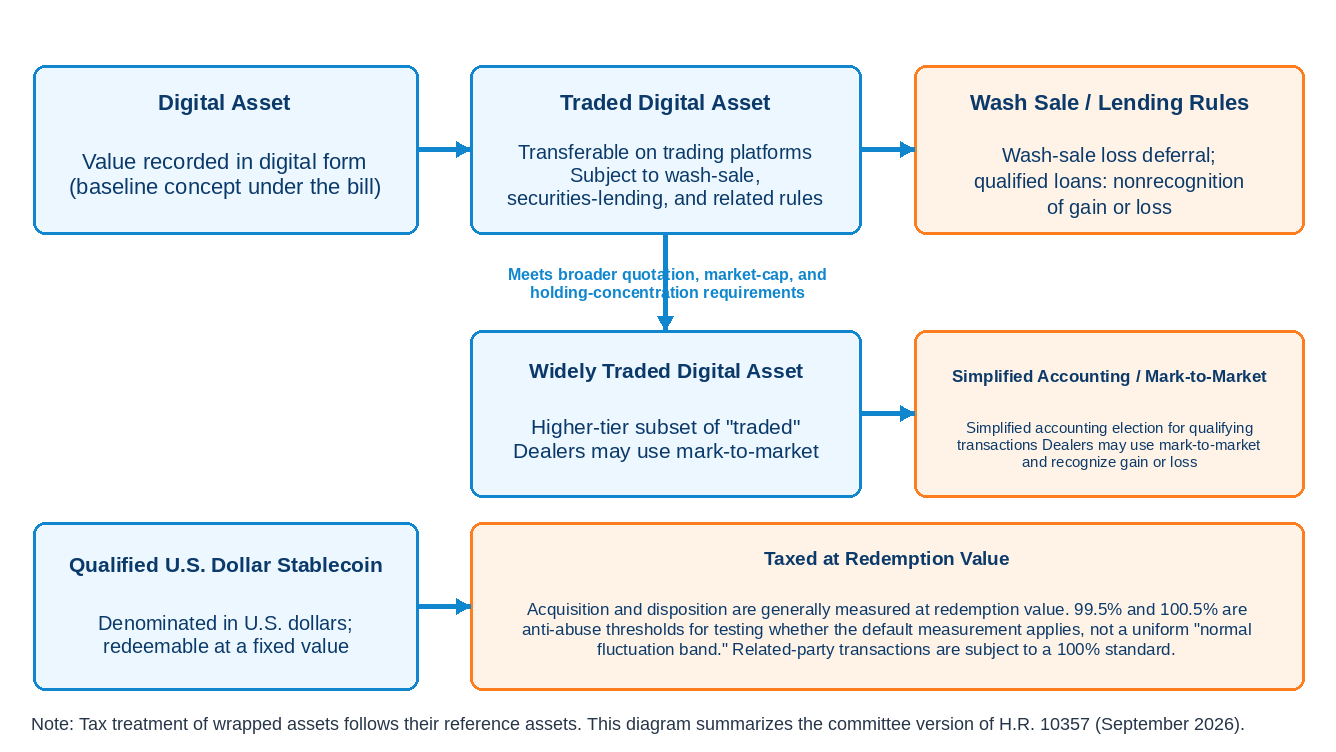
The tax issue for stablecoins arises from the tension between their treatment as property and their payment and settlement functions. Under general property rules, even small price movements around $1 can produce gains or losses that must be recorded. The Bill would use redemption value as the default tax reference for a “qualified U.S. dollar stablecoin.” On acquisition, basis generally would be determined by reference to redemption value. On sale or exchange, where acquisition basis equals redemption value, gain or loss generally would likewise be measured by reference to redemption value, thereby excluding small gains or losses arising from ordinary peg fluctuations. The 99.5% and 100.5% thresholds are anti-abuse tests used to determine whether the default measurement does not apply. For example, where a stablecoin is acquired or disposed of in exchange for non-cash property, its value must fall between 99.5% and 100.5% of redemption value. The rule would apply to taxable years beginning after December 31, 2026.
A “qualified U.S. dollar stablecoin” eligible for this treatment must satisfy the definition in the Bill and is tied to the payment-stablecoin issuer framework established by the GENIUS Act, enacted in July 2025. This includes stablecoins issued by permitted payment stablecoin issuers or qualifying foreign payment stablecoin issuers.
2 Further Refinement of Digital Asset Tax Rules
2.1 Transaction-Specific Rules
The Bill retains the framework established by the IRS in 2014 under which convertible virtual currency is treated as property. Its principal change is to add more specific tax rules for different asset characteristics and transaction scenarios. Low-value network and transaction fees receive a limited exception; qualified U.S. dollar stablecoins are generally measured by reference to redemption value; qualifying widely traded digital assets may be eligible for special accounting treatment; and existing financial-tax regimes, including the wash-sale and constructive-sale rules, are extended to the relevant digital assets.
Each group of provisions addresses a different operational issue in digital asset taxation. The de minimis fee rules reduce the burden of calculating gain or loss transaction by transaction for low-value fees. The stablecoin provisions address small gains or losses generated by ordinary peg movements. The rules for widely traded digital assets adjust the computation and measurement of gains and losses for assets with reliable market quotations. The wash-sale and constructive-sale provisions narrow differences between digital assets and traditional financial assets in the application of anti-abuse rules. Overall, the Bill retains the basic property-tax framework for digital assets while refining tax, accounting, and reporting treatment by asset category and transaction type.
2.2 Defining Digital Asset Categories
In 2014, the IRS stated in Notice 2014-21 that convertible virtual currency is treated as property for federal tax purposes and that general tax principles applicable to property transactions therefore apply. The Bill builds on that framework by introducing more granular asset categories and linking those categories to specific tax rules.
The Bill distinguishes among “digital assets,” “traded digital assets,” “widely traded digital assets,” and “qualified U.S. dollar stablecoins,” among other concepts. A “traded digital asset” emphasizes fungibility and the availability of market quotations and excludes specified tokenized digital assets. A “widely traded digital asset” is subject to additional conditions involving market quotations, market capitalization, and concentration of ownership; as a general rule, market capitalization must reach at least $500 million during the relevant period. A “qualified U.S. dollar stablecoin” is linked to regulatory qualifications applicable to its issuer.
Different classifications correspond to different tax treatments. Qualifying widely traded digital assets may be eligible for a simplified accounting election and, in specified cases, mark-to-market treatment. Traded digital assets may be subject to nonrecognition rules for qualifying digital asset loans, the wash-sale regime, and related provisions. Qualified U.S. dollar stablecoins may be measured by reference to redemption value. As a result, market liquidity, price discovery, economic function, and regulatory status can all affect the tax treatment of a particular asset.
Some elements of these classification standards would still require further administrative guidance. The Bill authorizes the Secretary of the Treasury to prescribe relevant determination standards and to issue additional rules for the simplified accounting election and related information reporting. For example, where market quotations are unreliable or readily susceptible to manipulation, or where market-capitalization or ownership-concentration requirements are not met, eligibility for treatment as a “widely traded digital asset” and the corresponding accounting, measurement, and reporting rules would depend on subsequent administrative guidance.
2.3 Tax Reporting and Data Requirements
As the rules become more granular, businesses must identify and retain more detailed data. The Bill would also modify broker reporting requirements so that the rules for de minimis fees, stablecoins, and simplified accounting can be coordinated with information reporting. In some circumstances, transaction-level reporting may be reduced or replaced by aggregate reporting, but brokers would still need data on sales, acquisitions, transaction amounts, and beginning- and end-of-period fair market value to support the relevant calculations and verification.
For trading platforms, tax determinations would increasingly need to be embedded in asset master data and transaction data. Platforms would need to identify whether an asset is a traded digital asset, widely traded digital asset, or qualified U.S. dollar stablecoin; distinguish ordinary sales from network fees, transaction fees, lending, staking, and derivatives transactions; and retain basis, fair market value, redemption value, and reference-asset relationships. At scale, these determinations are difficult to sustain through manual processing at the reporting stage.
The Bill would also require the Secretary of the Treasury to establish a digital-asset-specific voluntary disclosure program within one year after enactment. According to the JCT description, the program would be available to individuals with historical reporting errors arising from digital asset ownership or transactions and would need to specify eligibility, procedures for completing disclosure, and corresponding relief from civil penalties. Participants generally would still be required to pay tax due, interest, and any penalties prescribed by the program. The program would provide a channel for correcting historical noncompliance and obtaining penalty relief, rather than eliminating the underlying tax liability. Its precise scope and relief conditions would depend on the subsequent implementation framework.
3 Outstanding Legislative and Implementation Issues
At present, the Bill has completed consideration by the House Committee on Ways and Means. On September 16, the Committee first adopted the Chairman’s amendment in the nature of a substitute by voice vote and then voted 38–5 to report the amended Bill favorably to the full House. The legislation would still need to proceed through consideration by the House and Senate. The committee version nevertheless indicates several relatively clear policy directions: exceptions would reduce transaction-by-transaction accounting for low-value, high-frequency fees; regulated U.S. dollar stablecoins would receive specific tax treatment; and traditional anti-abuse regimes such as the wash-sale and constructive-sale rules would be extended to digital assets. These provisions provide a basis for understanding the direction of U.S. digital asset tax legislation at this stage.
Several issues remain unresolved in the committee version. A prominent example is the timing of income recognition for mining and staking rewards. A proposal considered in June 2026 included an elective recognition approach, but that provision was not incorporated into the current committee text. The Bill now primarily clarifies the character and source of the relevant income and does not establish a uniform change to the timing of reward recognition. Whether proposals omitted from the committee version reappear during later congressional consideration, and whether existing definitions, thresholds, or effective dates are revised, will depend on subsequent legislative text. Administrative implementation after enactment would also affect the practical scope of several provisions.
Since 2014, U.S. digital asset tax rules have gradually moved from a single property-treatment principle toward more granular classification-based rules. The Bill does not change the basic framework treating digital assets as property, but would add specific rules for stablecoins, traded assets, lending, professional trading, and validation activities, while extending traditional anti-abuse regimes such as the wash-sale rule to relevant digital assets. At this stage, businesses can use the committee text to identify potentially applicable rules, assess whether existing data can support asset classification, transaction characterization, basis calculations, and information reporting, and continue to monitor subsequent legislative text and Treasury implementation.
Send this FinTax note to your team.