2026 Global Crypto-Asset Tax Overview
This overview compares how major jurisdictions tax trading, staking, and mining, and where the rules are headed next.

Abstract
As crypto assets increasingly enter the mainstream financial system, tax treatment across jurisdictions has also moved from early rule gaps toward more formalized frameworks. In 2020, the OECD published Taxing Virtual Currencies, one of the earlier studies to systematically compare the tax treatment of crypto assets across multiple jurisdictions. Since then, as crypto markets have developed, more jurisdictions have clarified relevant tax treatment through existing tax laws, dedicated provisions, or tax guidance, while the procedural requirements and complexity of crypto taxation have continued to increase.
Under current frameworks, crypto-asset taxation is still largely built on traditional tax systems. Jurisdictions typically classify crypto assets based on the nature of the asset and the transaction, bringing them within existing income tax, capital gains tax, corporate income tax, and indirect tax regimes, with dedicated provisions or tax guidance used to clarify specific treatment. The maturity of the rules varies by activity: ordinary trading and mining entered tax systems earlier, while crypto-native activities such as DeFi and NFTs involve more complex asset exchanges, income recognition, and transaction structures, and their tax rules remain relatively less developed.
At the same time, tax treatment and effective tax burdens vary significantly across jurisdictions. Crypto assets may involve direct taxes, indirect taxes, and property-related taxes at the same time, while holding periods, transaction methods, the nature of the income, and taxpayer status can all change the tax outcome. Global crypto tax regimes are therefore moving from the basic question of whether crypto assets are taxable toward more granular classification and treatment of different assets, transactions, and economic activities.
Crypto Tax Rules Continue to Expand
Crypto assets entered formal tax systems relatively late. In 2020, the OECD published Taxing Virtual Currencies: An Overview of Tax Treatments and Emerging Tax Policy Issues, drawing on input from more than 50 jurisdictions to systematically compare the income tax, consumption tax, and property tax treatment of crypto assets. At the time, it was the first comprehensive study to cover such a broad range of jurisdictions. The OECD noted that analysis of the tax implications of crypto assets was still at an early stage across jurisdictions, with no consistent treatment yet established for fundamental issues such as asset characterization, taxable events, income classification, and valuation.
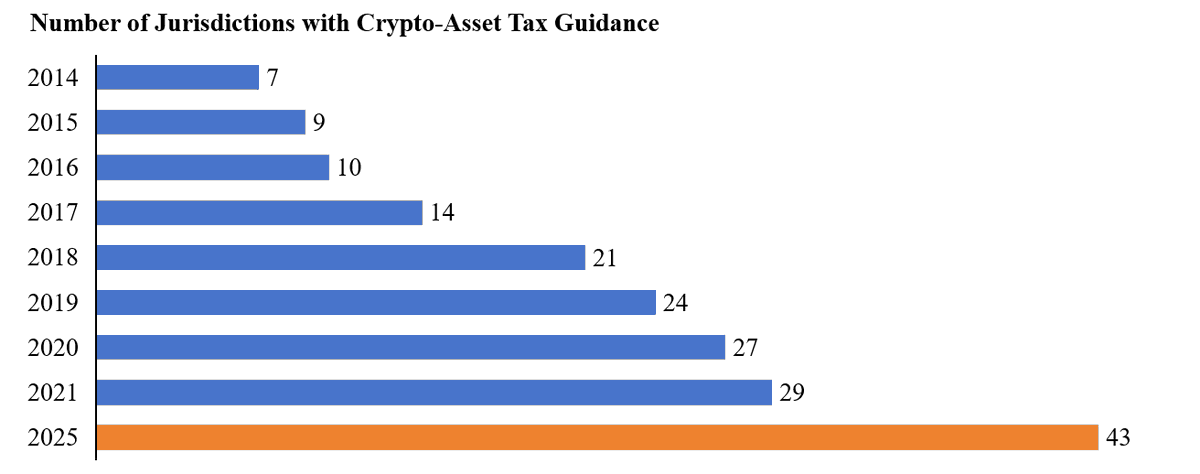
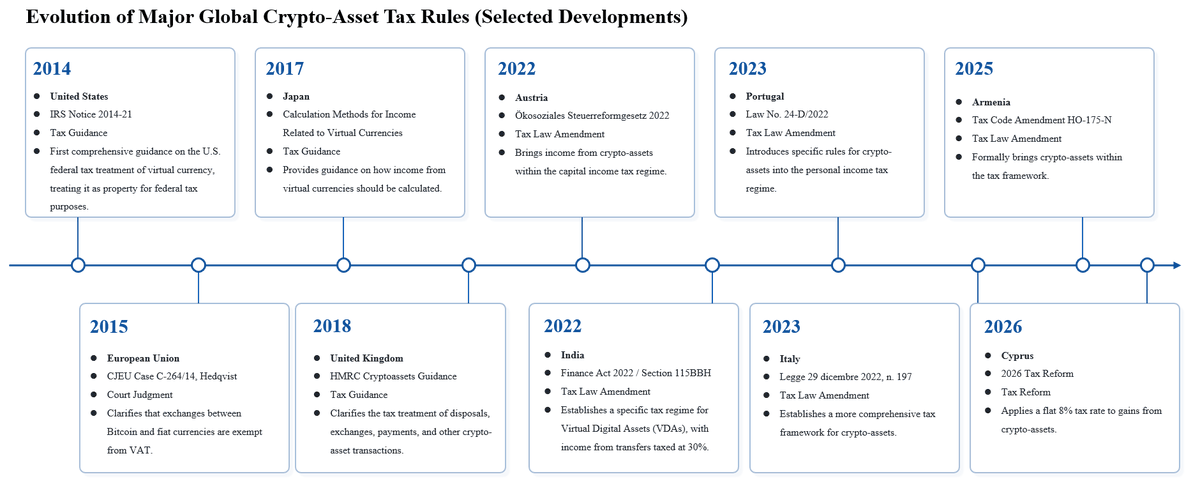
Since then, the coverage of crypto-asset tax rules has continued to expand. PwC data published in 2021 show that the number of jurisdictions with crypto-asset tax guidance increased from 7 in 2014 to 29 in 2021, more than quadrupling over seven years. By 2025, the figure had risen further to 43. Alongside broader coverage, existing frameworks have also become more detailed and extended to additional areas.
Existing Tax Systems Still Dominate, While Rule Maturity Varies
Crypto-asset taxation still relies primarily on existing tax systems. The United States continues to treat digital assets as property under general tax rules. Australia's 2025 tax review concluded that existing tax law is capable of covering digital asset transactions. A European Commission comparison of all 27 Member States found that most Member States address crypto assets within their existing tax frameworks, while corporate income from crypto activities is subject to corporate income tax across all Member States.
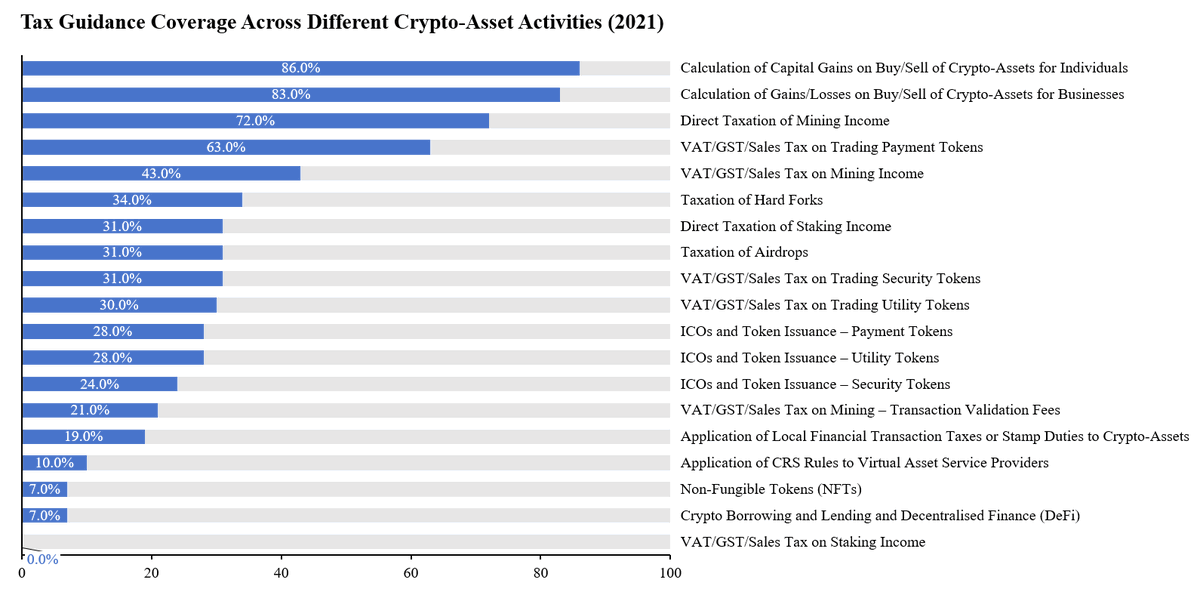
Tax rule coverage also varies significantly across crypto activities. In PwC's 2021 survey covering more than 40 jurisdictions, tax guidance existed for individual and corporate crypto-asset trading in 86% and 83% of jurisdictions, respectively, and for mining in 72%, compared with only 31% for staking and 7% each for DeFi and NFTs. By 2025, this divergence remained evident: Germany's latest income tax guidance on crypto assets covers multiple common transactions, but NFTs and liquidity mining are still not covered. Australia has likewise identified DAOs, DeFi, GameFi, and NFTs as areas requiring further study. Overall, the closer an activity is to traditional assets, income, and financial transactions, the more readily it can be accommodated within existing tax law; the more complex the on-chain structure, the more likely tax rules are to lag behind.
Tax Burdens Vary Significantly Across Jurisdictions
Crypto-asset taxation is highly complex. The tax burden is not determined by a single rate and may involve personal income tax, capital gains tax, corporate income tax, VAT or other consumption taxes, property taxes, inheritance taxes, and other taxes. The applicable treatment also depends on the nature of the transaction. Trading, payments, mining, staking, and business activities may give rise to asset disposals, investment income, or business income and may therefore be subject to different tax rules.
Accordingly, whether a jurisdiction is "crypto tax-friendly" requires a broader assessment based on individual needs and local rules. Beyond headline tax rates, relevant factors include tax residence, whether the taxpayer is an individual or a business, income classification, holding period, tax-free thresholds, and long-term holding incentives. The same jurisdiction may be favorable for long-term individual investors while imposing very different tax burdens on frequent trading, mining, or corporate activities.
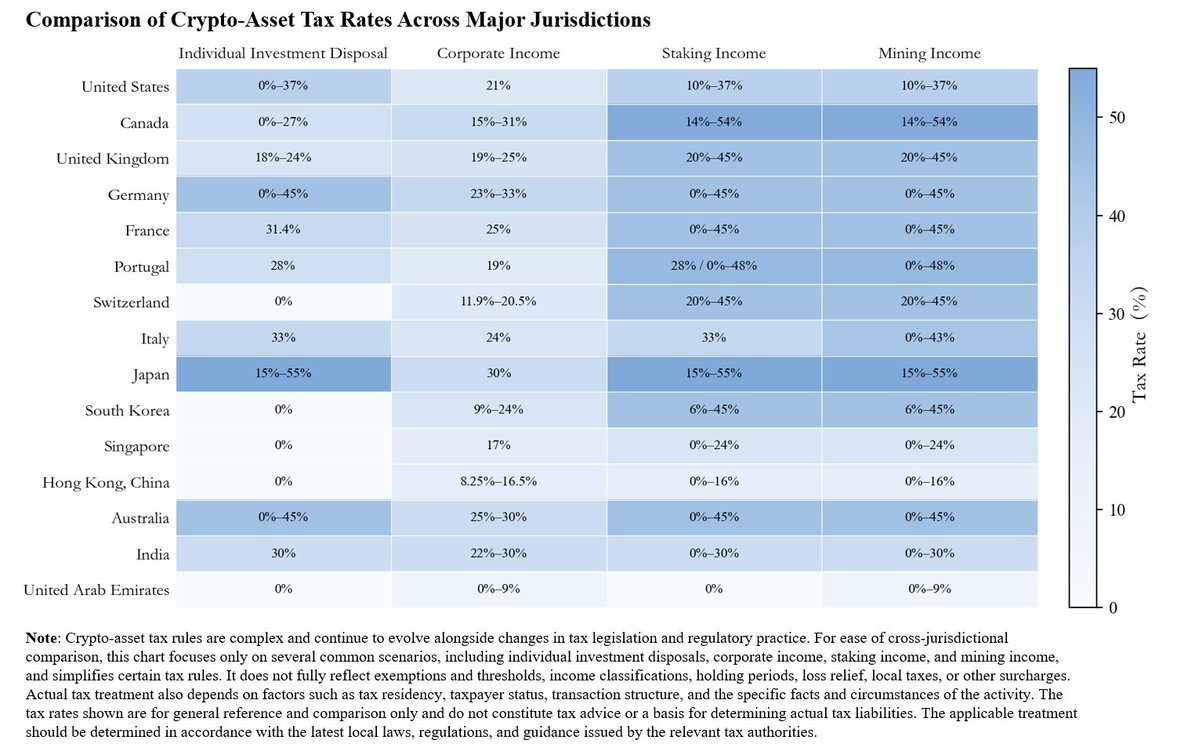
The figure below compares representative tax rates across major jurisdictions for common scenarios including personal investment disposals, corporate income, staking income, and mining income. The jurisdictions were selected with consideration given to economic scale, crypto-asset market activity, and regional representation, and the comparison highlights substantial differences in effective tax burdens across jurisdictions. Because crypto-asset tax rules are complex and continue to evolve, certain conditions and special rules have been simplified for readability. For a complete overview of the tax rules in a specific jurisdiction, please refer to our foundational crypto tax research series.
Conclusion
Looking across global practice, crypto assets have broadly entered mainstream tax systems, although jurisdictions continue to supplement and adjust their rules. The following developments stand out:
- Crypto-asset tax rules will continue to expand. Over the past decade, a growing number of jurisdictions have clarified the basic tax treatment of crypto assets, while earlier activities such as ordinary trading and mining have developed relatively mature rules. As the market evolves, regulatory attention will extend to more specific business scenarios, leaving further room for both broader coverage and greater detail.
- Existing tax systems will remain the primary basis for taxing crypto assets, but new business models will continue to raise questions of application. Most jurisdictions currently address crypto activities through traditional taxes such as income tax, capital gains tax, and corporate income tax, and this basic approach is unlikely to change in the near term. However, as tokenized stocks, on-chain securities, and other traditional assets move on-chain, a single product may combine characteristics of traditional financial assets with those of on-chain tokens. Future tax analysis will therefore depend more heavily on the underlying rights, transaction structure, and nature of the income, making the interface between existing tax law and new business models increasingly important.
- Individuals and businesses will need to pay closer attention to specific tax treatment. As crypto transaction types and business structures become more complex, the same asset or transaction may be subject to different tax rules depending on taxpayer status, holding purpose, transaction method, and income characterization. Relying only on asset classification or headline tax rates will increasingly be insufficient to assess actual tax exposure accurately. For individual investors and businesses alike, crypto tax management will require more professional judgment on transaction facts and applicable rules, as well as more systematic tax analysis and professional support.
Ultimately, crypto assets are one vehicle for economic activity, serving the investment, trading, and business needs of individuals and enterprises. Technology may continue to change, but taxation remains grounded in real economic activity and income outcomes; economic substance therefore remains central to determining the tax treatment of crypto assets. As crypto assets become further integrated into the real economy and financial system, this principle will become increasingly important.
Send this FinTax note to your team.