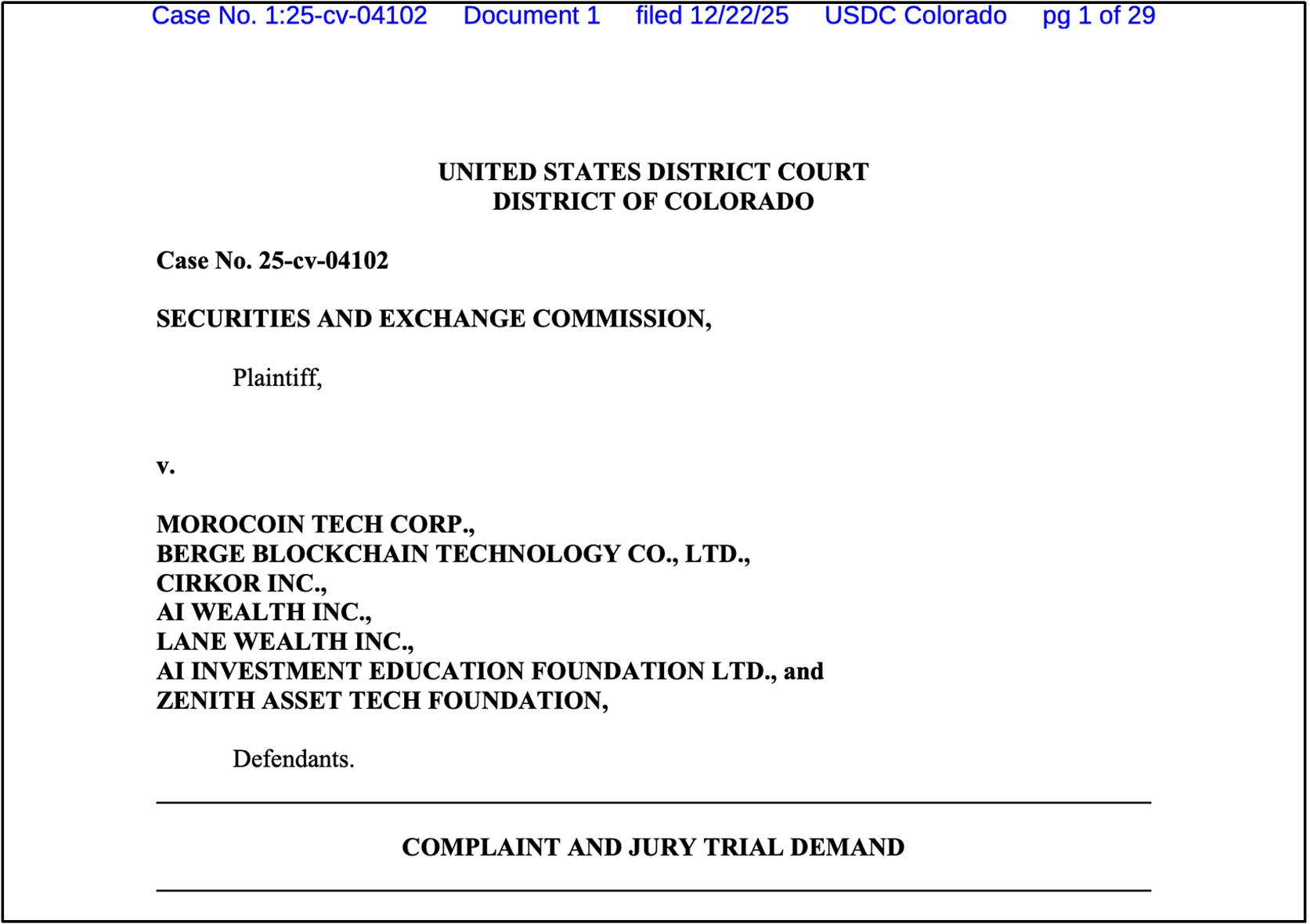
On December 22, 2025, the U.S. Securities and Exchange Commission (SEC) took heavy-handed action in the field of cryptocurrency regulation by filing a lawsuit against so-called crypto trading platforms such as Morocoin Tech Corp. and Berge Blockchain Technology Co. Ltd., as well as investment clubs like AI Wealth Inc. and Lane Wealth Inc. The SEC alleges that these entities conducted fraudulent trading and fake offerings via social media, illegally misappropriating approximately $14 million from retail investors. Currently, the SEC has asked the court for permanent injunctions, civil penalties, and the disgorgement of ill-gotten gains against the defendants, while warning investors not to easily rely on information from group chats for investment decisions. This enforcement action reveals the fraud risks existing in the crypto market and reflects the SEC's increasingly strict regulatory stance toward the crypto sector. This article will deeply deconstruct the key details of this case, analyze the SEC's enforcement basis and regulatory logic, and explore its impact on the Web3 financial ecosystem to provide a compliance reference for industry participants.
Link to the original complaint: https://www.sec.gov/files/litigation/complaints/2025/comp-pr2025-144.pdf
According to the complaint, since at least January 2024, AI Wealth, Lane Wealth, AIIEF, and Zenith used WhatsApp to operate so-called "investment clubs" and recruited investors into group chats through social media advertisements to carry out fraud. Within these WhatsApp groups, each investment club featured a "professor" and an "assistant." The professor was responsible for posting macroeconomic updates or stock market commentary, while the "assistant" handled communication with members. Fraudsters spread investment advice and posted screenshots of successful trades within the groups. With the help of AI-generated investment tips and forged endorsement videos from public figures, they boosted the confidence of retail investors, luring them to open accounts and deposit funds on fake crypto trading platforms such as Morocoin, Berge, and Cirkor. In reality, no actual trading occurred on these platforms; they merely featured sophisticatedly designed trading interfaces and fabricated trading data.
Subsequently, these investment clubs and trading platforms peddled so-called "Security Token Offerings" (also known as STOs) and claimed to have obtained government permits and regulatory licenses. By forging issuance qualifications, they created an illusion of legality and compliance to win investors' trust. In fact, the supposedly legal issuing companies did not exist. The STO products were neither issued on a real blockchain nor did they have any verifiable transaction history. The STOs purchased by investors were merely digital records on the platforms' internal ledgers, lacking any actual value or technical support.
When investors attempted to withdraw their principal and interest, the fraudsters would further demand additional fees such as "prepayments," "taxes," or "security deposits." They even lied, claiming that investors' accounts would be frozen due to an SEC investigation, thereby executing a secondary scam. This not only prevented investors from recovering their original funds but also attempted to trick them into investing more. Through a series of operations, the fraudsters illegally misappropriated at least $14 million from U.S. retail investors and quickly moved these funds overseas via bank accounts and crypto asset wallets. From beginning to end, these funds were never used for any form of real investment activity.
In this case, the activities essentially fell within the scope of securities regulation and involved fraud risks, giving the SEC clear room for regulatory intervention. The STOs involved were claimed to be issued by legitimate enterprises, using AI investment tips as bait to lure retail investors. These investors put in money based on trust in investment activities managed by others, expecting to gain returns through project profits. Although it was later discovered that the STOs and their issuers were fictitious, their promotion and operational model met the core elements of the Howey Test—investing in a common enterprise with an expectation of profits derived from the efforts of others—thus falling under "securities" regulation.
First, the SEC has statutory jurisdiction over fraudulent acts in the issuance and trading of securities, which is the primary prerequisite for its intervention. If a crypto asset is deemed a "security," the issuer must fulfill registration obligations with the SEC unless an exemption applies. The platforms involved did not obtain any licenses and evaded this obligation, making them more likely to attract targeted SEC enforcement.

Secondly, the scam model involved in the case has a distinct characteristic of "targeting retail investors," which aligns with the SEC's enforcement direction in recent years. On February 20, 2025, the SEC announced the establishment of the Cyber and Emerging Technologies Unit (CETU). Its core function clearly includes "protecting retail investors from bad actors in the emerging technology sector," with a heavy focus on retail fraud involving areas like artificial intelligence, blockchain technology, and crypto assets. In recent years, the SEC has handled several similar enforcement cases, such as the 2025 case where the SEC charged a Canadian citizen for allegedly conducting fraud against retail investors on Discord, and the 2024 case where the SEC charged two relationship investment scams involving fake crypto asset trading platforms NanoBit and CoinW6. These measures have refined the SEC's protection for retail investors and also reflect its regulatory emphasis on retail fraud in the field of emerging technologies.
Finally, from a regulatory logic perspective, the SEC's enforcement actions are not targeting any specific technical path or business model, but are based on its core responsibilities—protecting investors, maintaining fair, orderly, and efficient markets, and promoting capital formation. The SEC's intervention in the investigation is not only to hold people accountable, but also to curb the spread of similar scams through enforcement actions and avoid more retail investors from suffering losses. With the development of the digital economy, the SEC's responsibilities have extended from traditional securities markets to the field of crypto asset trading, as well as other emerging financing and trading models with securities attributes.
The SEC's charges revolve around two core pieces of securities regulatory legislation—the Securities Act of 1933 and the Securities Exchange Act of 1934. According to the complaint, the actions of the platforms and investment clubs involved violated the investor protection mechanisms of these aforementioned laws.
First, according to Section 17(a) of the Securities Act of 1933, the entities involved fabricated platforms and trading facts, which fits the fraudulent scenarios in the issuance and sale stages as stipulated in that section. Secondly, according to Section 10(b) of the Securities Exchange Act of 1934 and its supporting implementation rule, Rule 10b-5, the platforms involved violated the aforementioned anti-fraud provisions. Their illegal acts included fraud in the securities trading process and the diversion and manipulation of investor funds. From the perspective of application scope, Section 17(a) of the Securities Act of 1933 focuses on fraudulent acts in the issuance and sale of securities, emphasizing the responsibility of the issuer for false statements or concealment in information disclosure. On the other hand, Section 10(b) of the Securities Exchange Act of 1934 and its implementation rules cover both buyers and sellers in securities transactions, providing a broader scope of regulation.
As of now, the case is still in the trial process. The SEC has requested the court to issue permanent injunctions against all defendants to prevent them from continuing any securities issuance or trading activities. At the same time, it requires the defendants to disgorge ill-gotten gains with prejudgment interest, and pay civil penalties.
In the field of crypto assets, Initial Coin Offerings (ICOs) and Security Token Offerings (STOs) are two common fundraising methods. ICOs typically issue "Utility Tokens," which investors buy mainly to access a project's platform or services in the future, theoretically not relying on the efforts of third-party management for profit. In contrast, STOs issue "Security Tokens," whose value is usually linked to traditional securities (such as equity, debt, or profit-sharing rights), and investors rely on the efforts of the issuer or manager to obtain profits.

Regarding ICOs, the SEC implements differentiated regulatory rules. For non-security ICOs, on one hand, U.S. regulators have clarified the regulatory exemption standards for tokens with non-security attributes, simplifying regulatory requirements for utility tokens that only have scenario-based application functions and whose returns do not depend on third-party operations. On the other hand, regulatory agencies have also clarified token classification standards and regulatory boundaries to provide compliance guidelines for market participants. On May 12, 2025, SEC Chairman Paul Atkins proposed a token classification framework that classifies non-security tokens such as network tokens and NFTs under the jurisdiction of the CFTC to avoid excessive and overlapping regulation that stifles technical innovation. At the same time, the CLARITY Act established digital commodity standards; when tokens with a sufficient degree of decentralization lean toward commodity attributes, they will fall under CFTC regulation and be exempt from certain securities registration requirements, providing a clear path for compliant ICOs and reducing market expectations of compliance pressure. For ICOs identified as securities through the Howey Test, they must apply SEC regulatory rules and complete S-1 registration or meet exemption conditions such as Reg D or Reg A+.
The SEC adheres to the principle of "technology neutrality" regarding the regulation of STOs. On January 28, 2026, three divisions of the SEC jointly issued a statement on Tokenized Securities, emphasizing that the format of securities issuance or the method of record-keeping for holders (such as on-chain/off-chain) does not affect the application of federal securities laws. In other words, technology cannot change the economic substance of a security. If a certain type of token is intended to provide exposure to the value of a specific security, or if the core logic of its issuance and trading fits the attributes of a security, it should be included within the regulatory scope of federal securities laws.
Overall, the regulatory attitude of U.S. regulators toward token offerings has moved away from "one-size-fits-all" or pure reliance on enforcement, entering a stage of rule-based governance with clear classifications and distinct boundaries between securities and non-securities, while maintaining a regulatory core of substance over form. Whether it is an ICO or an STO, compliant platforms must meet regulatory requirements for Anti-Money Laundering and Know Your Customer (KYC/AML), prohibition of false statements and misleading promotion, and full disclosure of risks.
The healthy development of the crypto market is inseparable from the cornerstone of trust. Through this case, it can be seen that when fraudsters use crypto shells and complex technologies to "weave" scams, what they destroy is not only the wealth of retail investors, but more importantly, the confidence of the market in the Web3 financial ecosystem. Every successful cashing out of "bad money" may cause "good money," which is truly dedicated to technical innovation and compliant operation, to bear a heavier cost of trust. Avoiding this vicious cycle relies on the joint efforts of regulatory agencies of various countries, Web3 participants, and investors. Only in this way can a transparent and stable market environment be established, pushing crypto assets toward a broader stage.

FinTax offers crypto accounting suite, tax calculator and professional tax consulting services.