What Changed in Crypto in 2026?
As 2026 gets underway, the global crypto industry is going through a series of structural shifts.

Summary
As 2026 gets underway, the global crypto industry is going through a series of structural shifts. In its 2026 Digital Assets Outlook, The Block highlights regulation, infrastructure, stablecoins, DeFi, and institutional participation as major forces shaping the industry's development. Fidelity Digital Assets focuses on “structural changes beyond price,” arguing that attention is moving away from asset prices alone and toward liquidity structures, tokenized use cases, and new technology infrastructure. PwC's Global Crypto Regulation Report 2026 further notes that stablecoins have become a central topic in global regulatory policy, with jurisdictions refining rules on issuer eligibility, reserve assets, redemption arrangements, and ongoing supervision. Citi describes the shift as stablecoins moving “from Web3 to Wall Street,” as their use gradually expands from within crypto markets into traditional financial settings such as payments, banking, and corporate treasury management.
From a finance, tax, and compliance perspective, these changes affect how value moves, where the boundaries of regulated business sit, who initiates transactions, and who is responsible for reporting information. Together, they are bringing crypto further into the real-world business system. More specifically, the key changes in 2026 can be grouped into four areas:
• Stablecoins are changing how value moves;
• Global regulation is changing the boundaries of business operations;
• AI is changing who initiates transactions;
• Tax transparency is changing information-reporting responsibilities.
I. Stablecoins Move Beyond Crypto as Real-World Payments and On-Chain Settlement Converge
1. Stablecoins Keep Growing, but On-Chain Activity Still Dominates
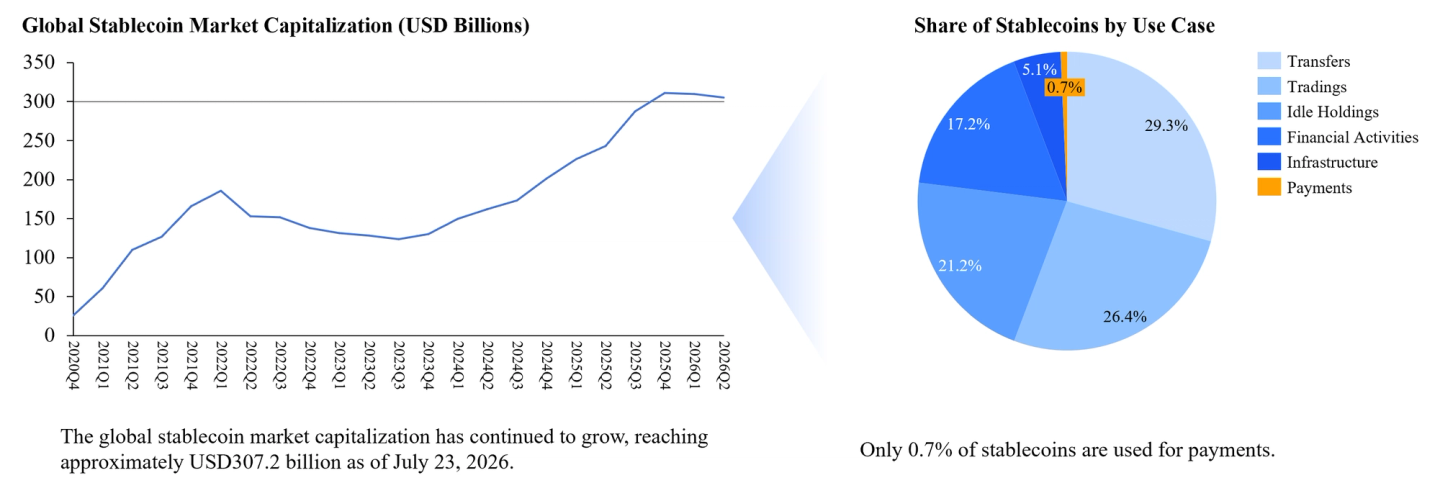
A 2026 BIS study notes that the stablecoin market has grown beyond USD300 billion, with around 98% of stablecoin value denominated in U.S. dollars. Stablecoins are gradually moving beyond their original roles as trading quote assets and places to park funds, becoming a channel for cross-border value transfers. Even so, most activity still relates to crypto-native uses such as trading, arbitrage, and liquidity management.
An April 2026 estimate from the Federal Reserve Bank of Kansas City shows that around 48.8% of stablecoin activity relates to exchanges, DeFi, and related financial infrastructure, while 29.3% relates to fund transfers. Payments for goods and services in the traditional sense account for only around 0.7%. Stablecoins have already created a sizable pool of on-chain liquidity, but for now they are still used mainly for crypto trading, on-chain finance, and treasury transfers.
2. Real-World Payments Grow as Stablecoins Move Behind the Scenes of Traditional Payment Products
Research by Artemis shows that monthly stablecoin payment volume rose from around USD1.9 billion in January 2023 to around USD10.2 billion in August 2025, roughly 5.4 times the original level. Growth has come from business-to-business payments, payroll and freelancer settlements, card spending, merchant payments, and cross-border remittances. B2B stablecoin payments have been especially strong. Adoption does not always mean that consumers directly operate on-chain wallets. More often, bank cards, payment apps, or corporate payment platforms use stablecoins in the background to settle transactions.
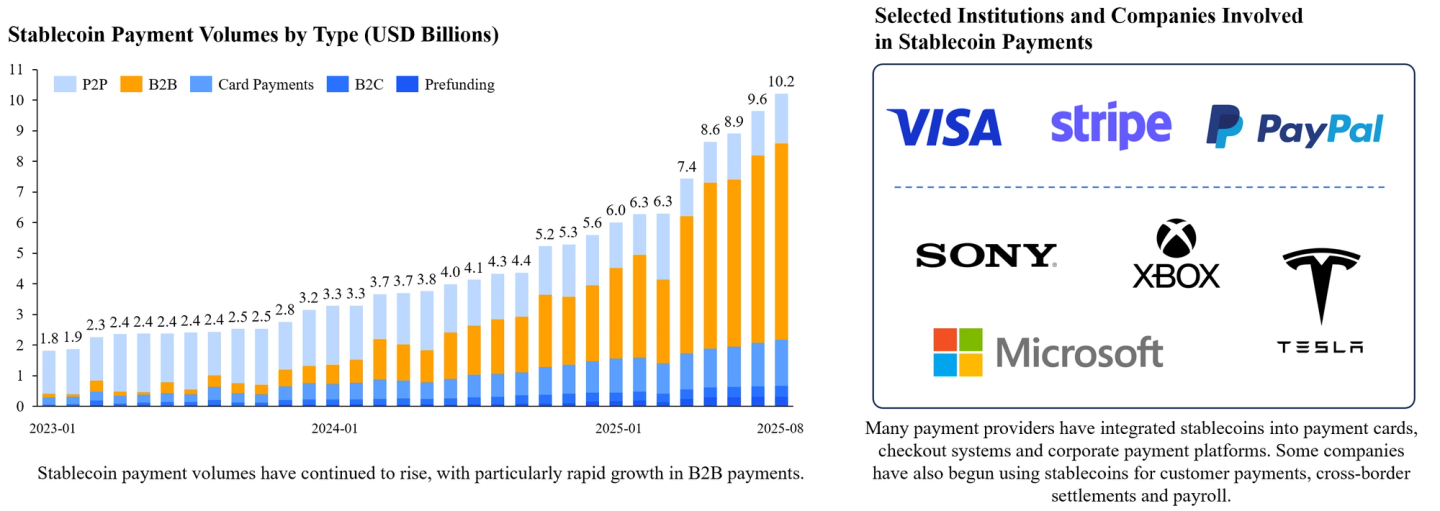
Source: Artemis, Stablecoin Payments at Scale, January 2026. The chart shows monthly payment volumes disclosed in the report.
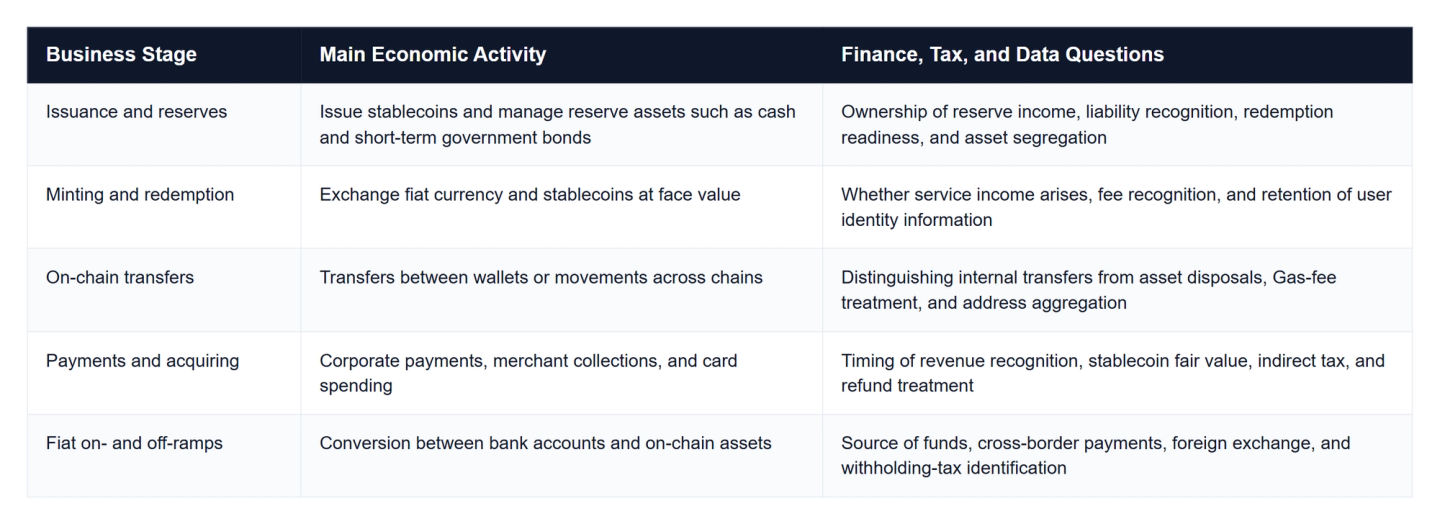
3. Longer Business Chains Turn Accounting and Tax from Isolated Issues into End-to-End Workflows
Once stablecoins enter real-world business operations, the participants are no longer limited to issuers and trading platforms. The chain also includes reserve custodians, minting and redemption service providers, payment processors, card issuers, wallet providers, and fiat on- and off-ramp providers. Each participant may earn a different type of income and carry different tax obligations and data responsibilities.
II. Global Regulation Moves into the Enforcement Stage, with Licensing Giving Way to Ongoing Supervision and Cross-Border Constraints
1. Comprehensive Regulatory Frameworks Are Taking Shape, but Implementation Still Varies Across Regions
The FSB's latest comparable review of 28 jurisdictions shows that, as of August 2025, 11 jurisdictions had completed comprehensive crypto regulatory frameworks covering financial stability risks, eight were consulting on or finalizing their frameworks, three had only partial coverage, and six remained at an early stage. Even in regions with more complete CASP frameworks, regulatory reporting capabilities were still clearly lagging. Of the 19 jurisdictions that the FSB identified as having completed comprehensive CASP frameworks, only 11 had relatively extensive regulatory reporting requirements.
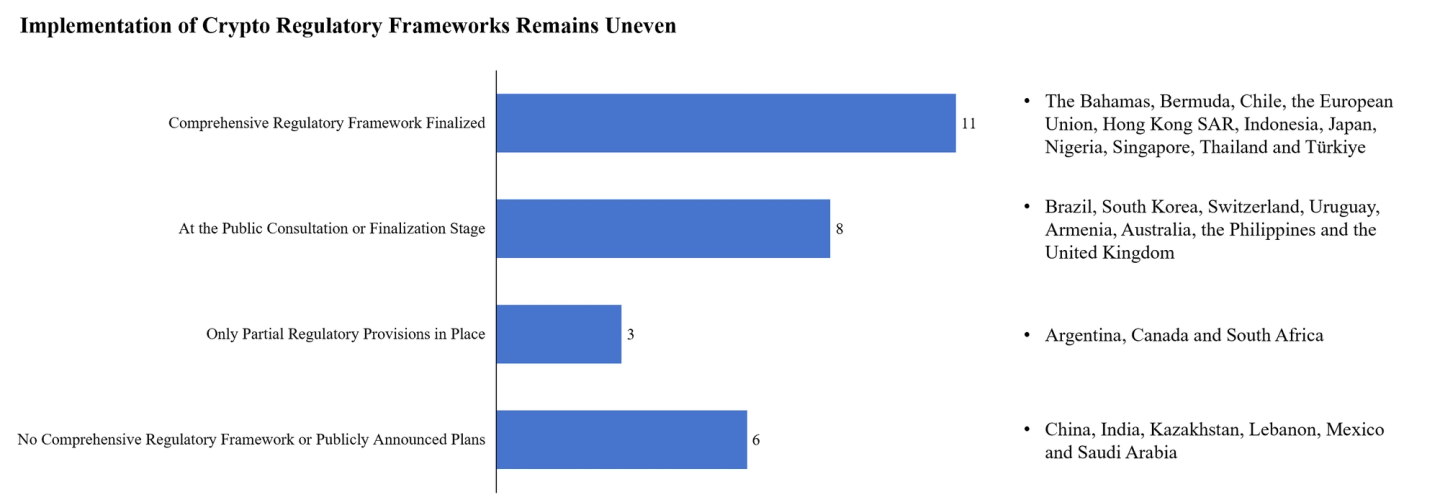
Source: FSB, Thematic Review on FSB Global Regulatory Framework for Crypto-asset Activities, October 2025.
The FSB assessed the 28 jurisdictions participating in this peer review using a consistent methodology; the review does not cover every jurisdiction. The United States did not submit the review questionnaire because federal stablecoin legislation and digital asset regulatory policy were still being developed during the assessment period. It was therefore excluded from the four-stage classification, although the report still reviewed relevant U.S. developments using publicly available information.
2. Under Frameworks Such as MiCA, Licenses Determine Whether Client Services and Products Can Continue
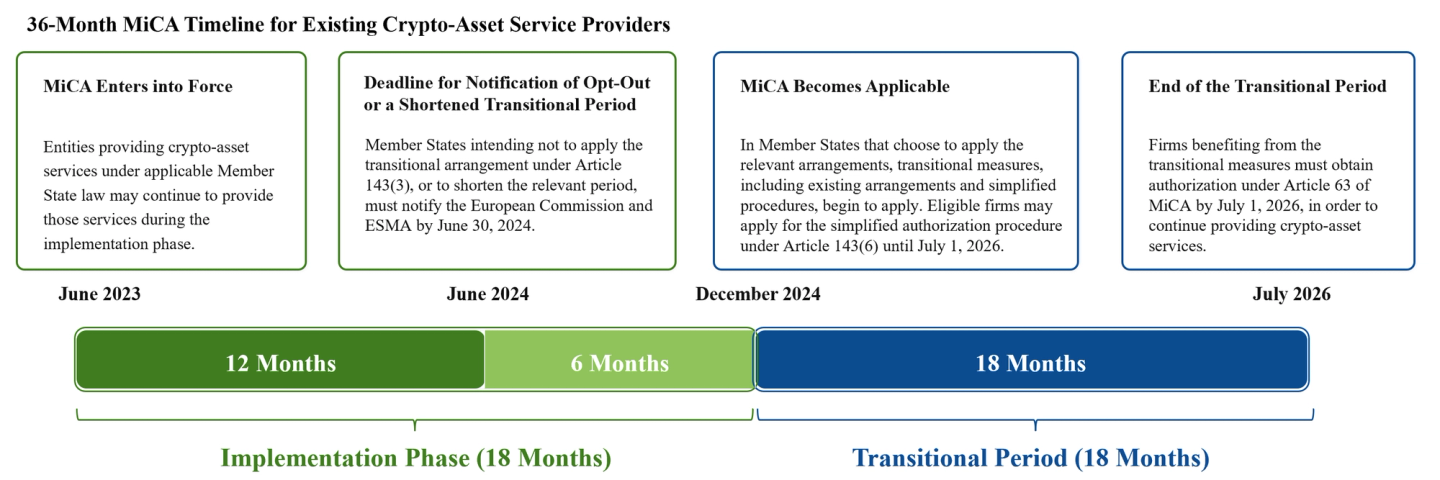
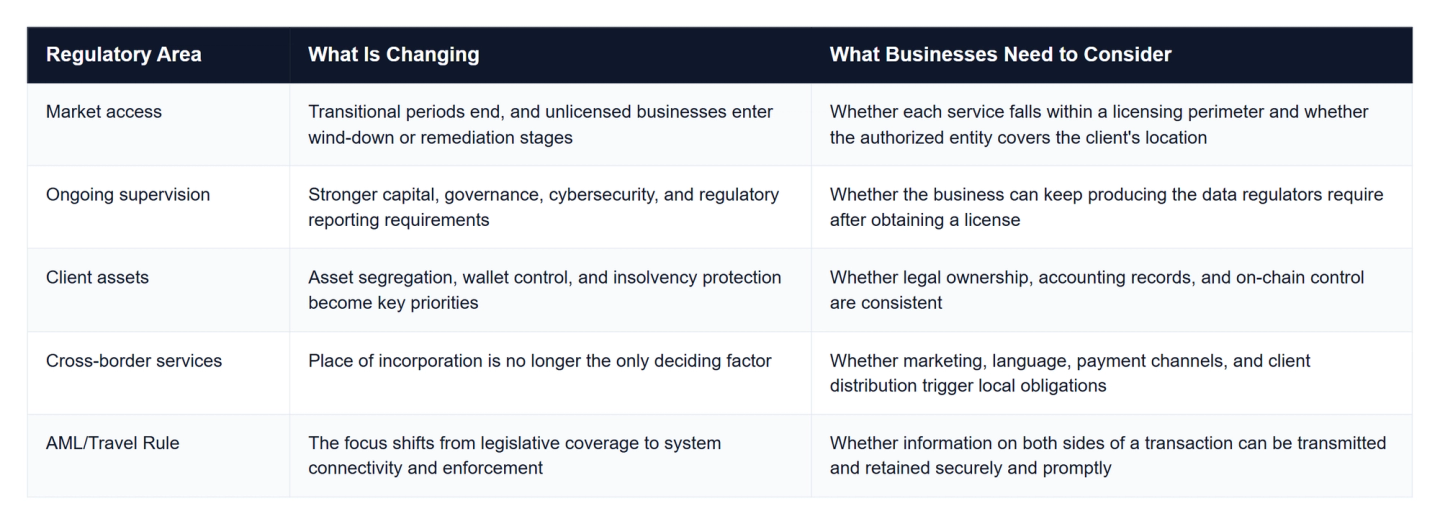
The EU's MiCA transitional period formally ended on July 1, 2026. ESMA made clear that firms continuing to provide crypto-asset services to EU clients without MiCA authorization must stop the relevant activities and complete an orderly client migration and business wind-down. Regulation has now moved from rulemaking into real operating constraints. Whether a platform can continue onboarding clients, marketing, providing custody, or offering trading services depends on the scope of its authorization and its legal-entity arrangements, rather than simply on historical registrations or offshore licenses.
For multinational crypto businesses, the basic unit of regulatory assessment is also changing. Supervision is moving away from reviewing a group as a whole and toward an entity-by-entity, service-by-service approach. Each service needs to be linked to a specific operating entity and a clearly assigned regulatory responsibility.
3. Anti-Money Laundering Rules Cover More Markets, but Enforcement and Cross-Border Activity Are the Next Focus
FATF's 2026 survey found that 91 of the 109 responding jurisdictions had passed laws implementing the Travel Rule, equal to 83%, up from 73% in 2025. However, 55 of those 91 jurisdictions had not yet published inspection findings, issued supervisory directions, or taken related enforcement action. FATF also noted that offshore VASPs, unhosted wallets, P2P transactions, cross-chain tools, and DeFi arrangements remain difficult areas for regulators.
The EU's Transfer of Funds Regulation requires CASPs to transmit payer and payee information in crypto-asset transfers. Australia began phasing in its virtual-asset Travel Rule in 2026 and requires institutions to identify counterparties and distinguish between hosted and unhosted wallets. For offshore VASPs serving local clients, some jurisdictions have introduced mandatory registration, public warnings, app-store removals, and restrictions on access to local financial institutions. The next challenge for businesses is whether their systems can exchange payer and payee information, identify cross-border services aimed at local residents, and continuously provide regulators with complete, consistent, and verifiable data.
III. AI Agents Emerge as New Transaction Actors, Reshaping Transaction Records and Accountability
1. Stablecoins Give AI Agents an Internet-Native Way to Pay
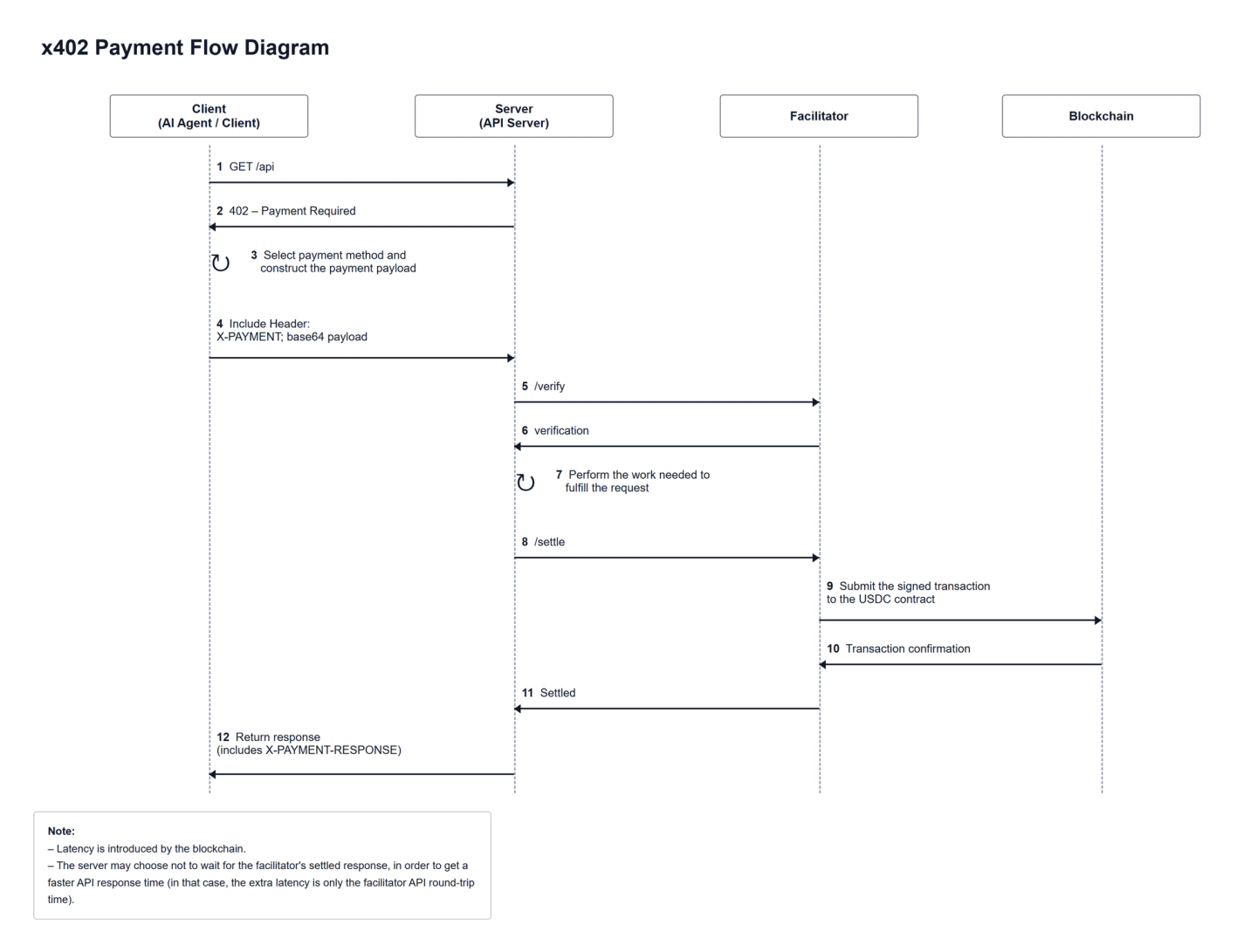
Coinbase's x402 protocol uses the HTTP402 status code to let a website or API request a stablecoin payment as soon as it receives a service request. The client can complete the payment and submit the request again without a traditional account, session, or complex authentication process. The mechanism works for human users, but it also suits AI Agents that need to automatically purchase data, computing power, model inference, or other digital services.
Compared with card payments and bank transfers, Agent payments are usually smaller, more frequent, triggered in real time, and charged per use. Because programmable stablecoin transfers and wallet signatures can connect directly with software requests, stablecoins have become an important technical route for machine-to-machine payments.
Source: Live data from x402.org, accessed July 23, 2026. The figures change over time.
2. Machine Payments Are Reaching Scale and Producing Highly Automated Data
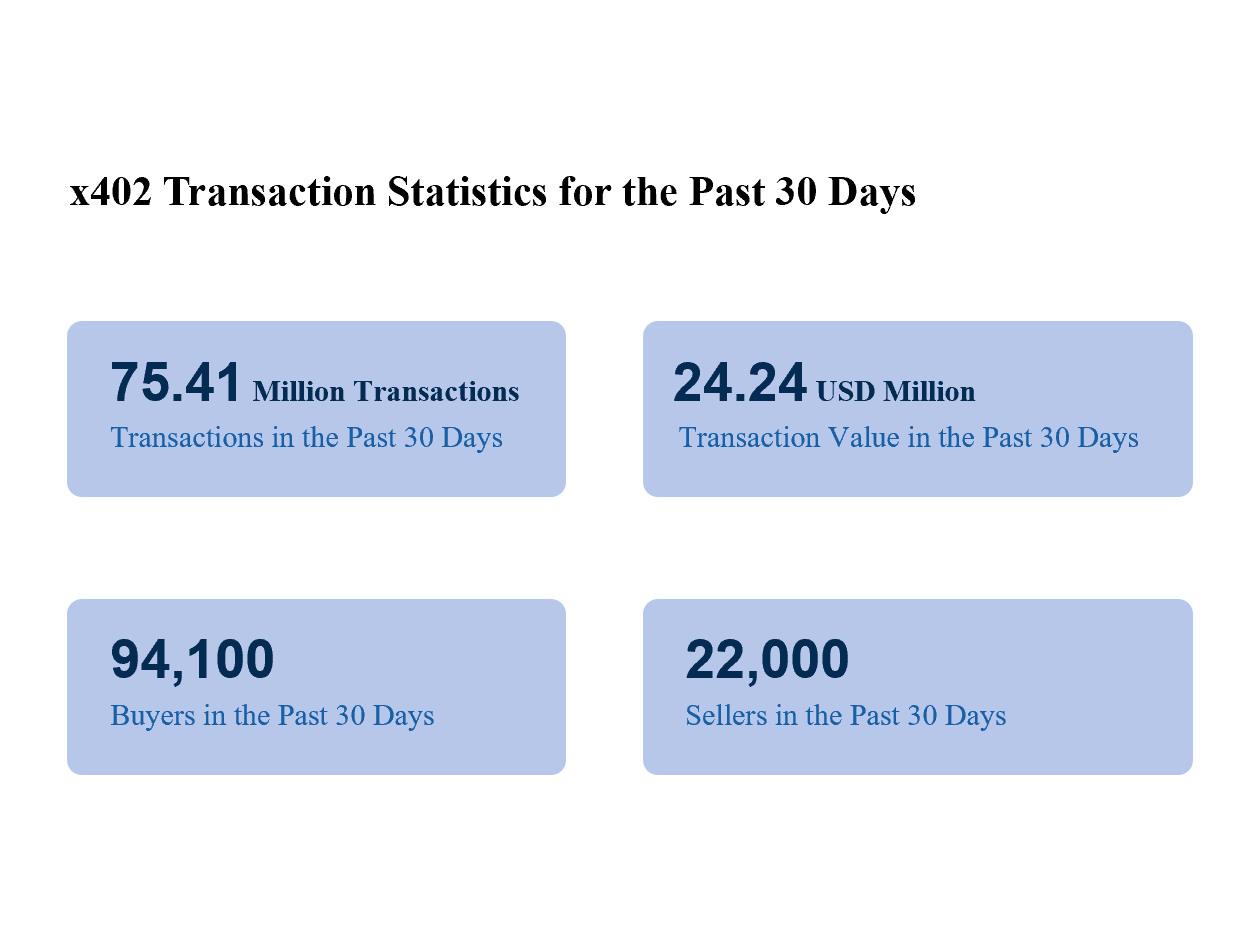
In its first-quarter 2026 results, Coinbase disclosed that x402 had processed more than 100 million payments in total, with more than 99% of transactions using USDC. On July 23, 2026, the x402 website showed around 75.41 million transactions over the previous 30 days, with a total value of around USD24.24 million, approximately 94,100 buyers, and approximately 22,000 sellers. Individual machine payments may be small, but transaction counts and the number of participants are growing quickly.
Source: Live data from x402.org, accessed July 23, 2026. The figures change over time.
3. AI Agents Require a New Approach to Transaction Authorization, Tax Attribution, and Audit Evidence
When an AI Agent completes transactions autonomously on behalf of a business, an on-chain signature only proves that a wallet issued an instruction. It does not automatically prove that the transaction complied with the company's authorization rules, procurement policies, or tax requirements. At a minimum, businesses need to retain records of the Agent's identity, the principal it represents, its permission scope, triggering conditions, counterparties, the services involved, and any human intervention.
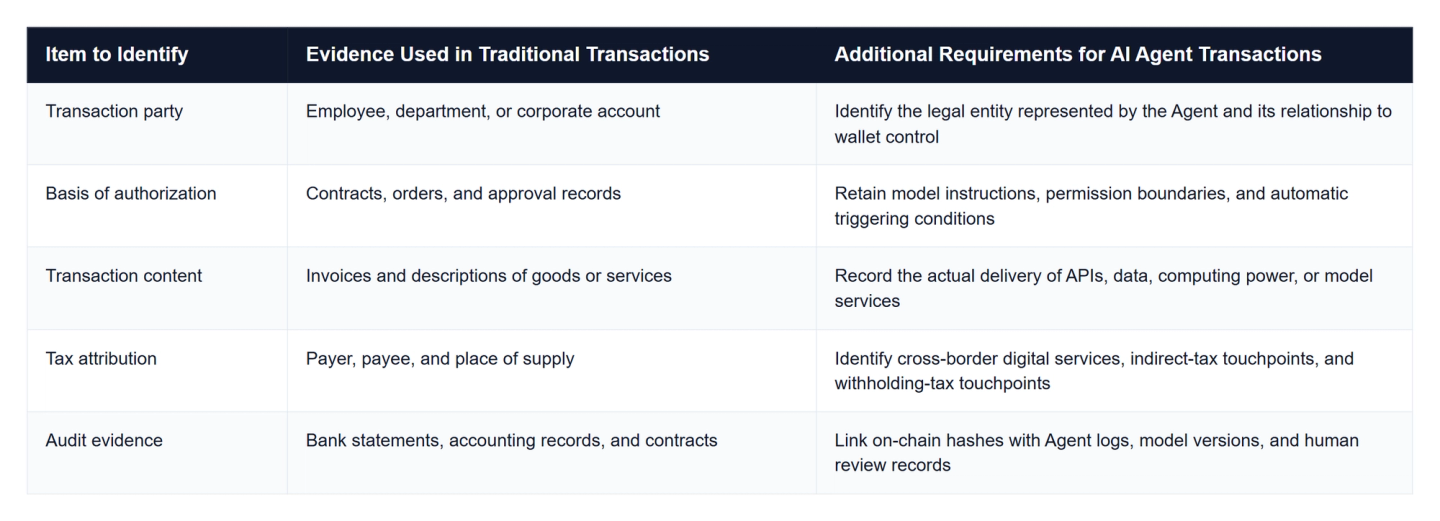
AI can also support transaction classification, journal-entry generation, tax-event identification, and anomaly detection. However, AI outputs used in finance and tax need verifiable data sources, clear decision rules, complete processing logs, and records of human adjustments. Businesses will face two tasks at once: handling the large volume of machine transactions generated by AI, and demonstrating that AI-generated compliance results can be audited and reviewed.
IV. Tax Transparency Moves into Implementation, as Platform Reporting Reshapes Crypto Data Governance
1. CARF Implementation Expands Worldwide, Making 2026 a Key Year for Systems and Data Collection
According to the list published by the OECD Global Forum on Transparency and Exchange of Information for Tax Purposes as of June 23, 2026, 76 jurisdictions had formally committed to implementing CARF. Of these, 46 plan to begin exchanges in 2027, 29 plan to begin in 2028, and the United States plans to begin in 2029. For jurisdictions starting exchanges in 2027, 2026 is already the first information-collection period. Tax authorities need to complete domestic legislation and reporting rules, while RCASPs need to begin user due diligence, transaction classification, data retention, and reporting-system upgrades. Jurisdictions beginning exchanges in 2028 and 2029 will similarly enter their preparation stages in the preceding year.
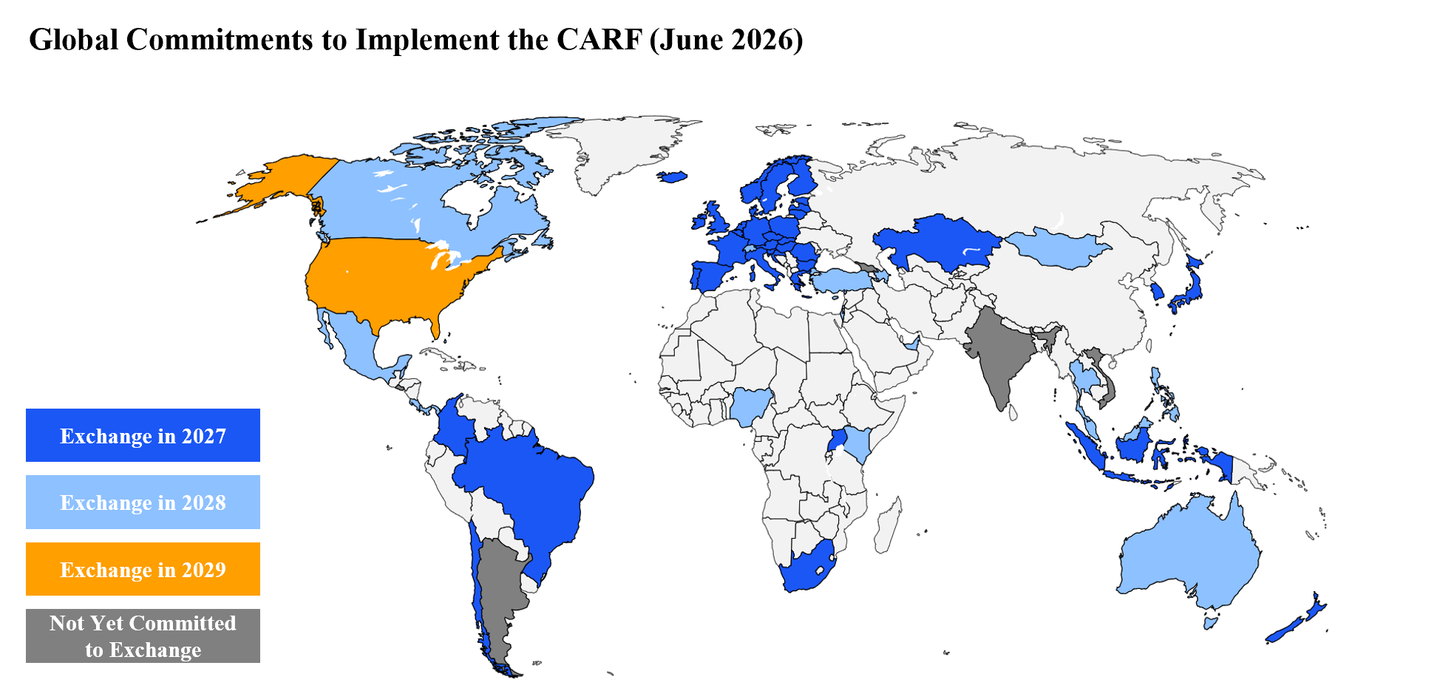
Source: OECD Global Forum on Transparency and Exchange of Information for Tax Purposes, Jurisdictions Committed to Implement the CARF, updated June 23, 2026.
2. DAC8 and Form1099-DA Give Platforms Direct Reporting Responsibilities
The EU's DAC8 has applied since January 1, 2026, bringing crypto-asset transactions into the scope of administrative cooperation and automatic exchange of tax information. Reporting crypto-asset service providers need to identify users and prepare transaction reports. In the United States, digital asset brokers must report transactions through Form1099-DA. Gross-proceeds reporting applies to relevant transactions occurring after January 1, 2025, while cost-basis reporting for certain covered digital assets is being phased in for transactions occurring after January 1, 2026.
Tax authorities no longer rely entirely on individuals to disclose information voluntarily. Instead, they use platform data to identify taxpayers' asset disposals, income, and cross-border holdings. For platforms, tax obligations are no longer limited to their own corporate income tax; they now extend to classifying, validating, and reporting user transactions.
3. On-Chain Data and Tax Data Are Still Far Apart
A blockchain can show addresses, timestamps, Token amounts, and transaction hashes, but it usually cannot directly tell who owns an address, whether a transaction changed ownership, whether a transfer was a sale or an internal movement, how cost basis should be determined, or where a user is tax resident. Tax reporting therefore requires on-chain records to be connected with platform account information, tax-residency self-certifications, fiat transaction records, and the business logic of each product.
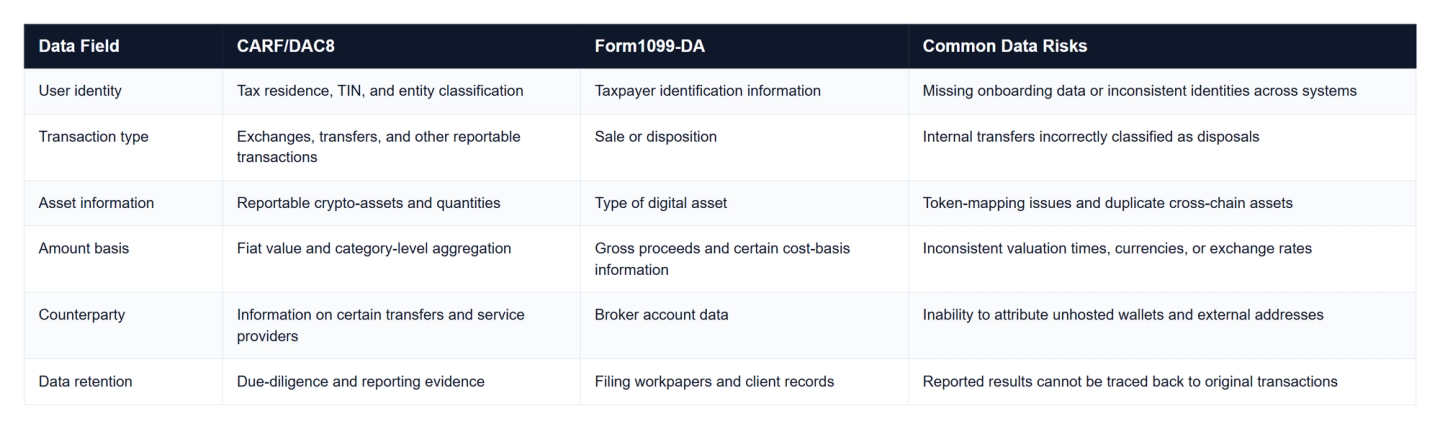
When CARF, DAC8, Form1099-DA, the Travel Rule, corporate accounting, and audit all rely on the same user and transaction data, data consistency becomes a new compliance risk. If user identities, asset classifications, amounts, or cost basis conflict across systems, a business may not only file incorrect reports but also struggle to explain differences between tax filings, financial books, and regulatory reports.
Crypto Compliance Is Becoming Core Infrastructure
From a crypto finance and tax perspective, the four changes above all point in the same direction: crypto businesses are moving deeper into real-world operations and cross-border regulatory systems. Stablecoins are expanding payment and settlement use cases, AI Agents are increasing transaction automation, and regulatory and tax rules require transactions to be accurately linked to specific parties and supported by continuous, verifiable records.
Against this backdrop, crypto compliance can no longer rely only on one-off legal assessments or period-end filings. Businesses need data and control systems that run through day-to-day operations. Only when customer, account, wallet, transaction, accounting, and reporting data remain consistent can a company continue meeting the requirements of cross-border operations, regulatory reporting, and audit review. In that sense, crypto compliance is becoming a basic condition for keeping the business running.
Send this FinTax note to your team.