EU MiCA Transitional Arrangements Expire: Understanding MiCA and Its Impact on Crypto Service Provid
MiCA is the European Union’s first unified regulatory framework for crypto-assets.

1 The CASP Transitional Period Has Ended, Leaving Most Firms Without EU Operating Authorisation
MiCA is the European Union’s first unified regulatory framework for crypto-assets. It primarily covers crypto-assets, crypto-asset issuance and crypto-asset services that were not already regulated under existing EU financial services legislation, and establishes a systematic set of rules on transparency requirements, disclosure obligations, authorisation procedures and trading supervision. Before MiCA was implemented, European countries maintained separate crypto-asset regulatory regimes, and crypto-asset service providers mainly operated under VASP registration or anti-money laundering registration regimes at Member State level. Registration thresholds, review priorities and supervisory intensity varied from country to country, and registration in one jurisdiction generally did not automatically permit a service provider to operate throughout the EU. MiCA is intended to address this regulatory fragmentation: once a service provider obtains authorisation as a crypto-asset service provider (CASP), it may, in principle, provide services across all 27 Member States through the MiCA passporting mechanism.
MiCA entered into force in June 2023. The rules relating to stablecoins, including asset-referenced tokens (ARTs) and e-money tokens (EMTs), have applied since 30 June 2024, while the CASP authorisation rules have applied since 30 December 2024. MiCA introduced transitional arrangements for entities that had already been lawfully providing services under Member State law, allowing them to continue operating for a limited period. The maximum transitional period at EU level was 18 months, although each Member State could decide to shorten it. Germany, for example, adopted a 12-month period, while Finland allowed only six months.1
The overall MiCA transitional period ended on 1 July 2026. Since then, cryptocurrency exchanges, brokers and wallet service providers without MiCA authorisation have no longer been permitted to continue providing the relevant services to EU users. According to Hogan Lovells, more than 3,000 crypto businesses were registered and operating in 2024. By contrast, only approximately 280 firms had obtained CASP authorisation at the time of writing, a figure far below the size of the market before MiCA was implemented. An estimated 75% of existing firms may lose their ability to operate, including well-known crypto trading platforms such as Binance, MEXC and HTX.
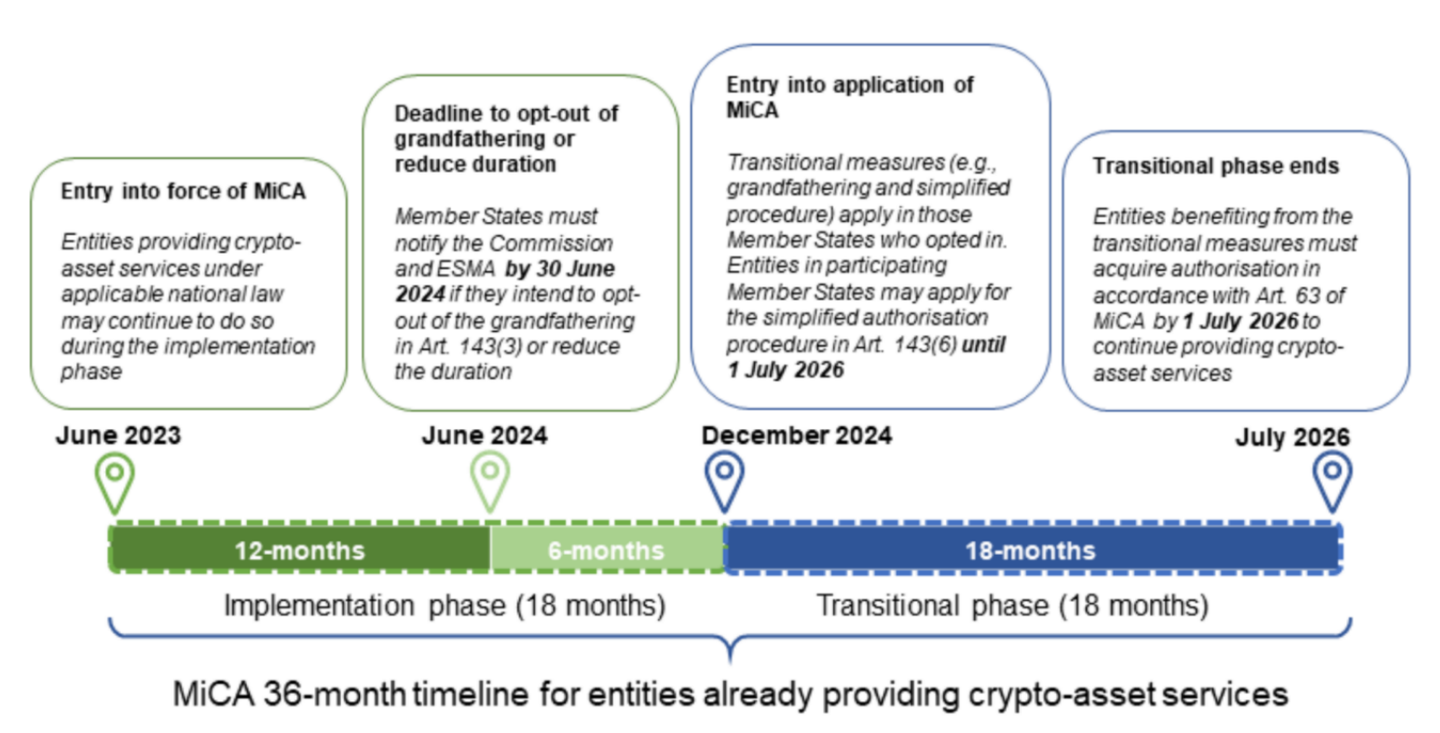
With the transitional window now formally closed across the EU, the European crypto market has entered a clearer phase of authorised operation. Any crypto-asset service provider without MiCA authorisation should cease the relevant business activities. This includes stopping the onboarding of new clients, ending marketing and client-solicitation activities, and guiding existing users to withdraw their assets or transfer them to authorised institutions. The provider’s activities must be limited to those strictly necessary for an orderly wind-down; otherwise, it will be acting unlawfully. Some national regulators may also block websites and publish warning lists to ensure effective implementation of the authorisation regime.4
2 What Is MiCA? A Review of Its Core Rules
MiCA is implemented through a combination of EU-level coordination and enforcement by the competent authorities of the Member States. The European Banking Authority (EBA) and the European Securities and Markets Authority (ESMA) are responsible for developing technical standards, coordinating supervision and performing certain direct supervisory functions. The authorisation and ongoing supervision of CASPs, however, remain primarily the responsibility of the market regulators and central banks designated by each Member State. In France, for example, domestic supervisory responsibilities are shared by the Autorité des Marchés Financiers (AMF) and the Autorité de Contrôle Prudentiel et de Résolution (ACPR). In Croatia, they are performed by the Croatian National Bank and the Croatian Financial Services Supervisory Agency (HANFA), while in countries such as Slovakia and Hungary the central bank serves as the competent authority.
MiCA applies to natural persons, legal persons and other undertakings that issue crypto-assets, offer crypto-assets to the public, seek their admission to trading or provide crypto-asset services within the EU. Its core rules can be summarised as follows:
2.1 Asset Classification
MiCA defines a crypto-asset as a digital representation of a value or of a right that is capable of being transferred and stored electronically using distributed ledger technology or similar technology. Under the MiCA framework, crypto-assets can broadly be divided into three categories.
The first category is e-money tokens (EMTs), meaning crypto-assets that purport to maintain a stable value by referencing the value of one official currency. Functionally, they are similar to electronic money. USDC and USDT are commonly discussed under this category.
The second category is asset-referenced tokens (ARTs), meaning crypto-assets that purport to maintain a stable value by referencing the value of several official currencies, one or more commodities, one or more crypto-assets, or a combination of such assets.
The third category consists of other crypto-assets, including utility tokens (UTs). A utility token is intended only to provide access to a good or service supplied by its issuer and is made available on a distributed ledger.
2.2 Regulatory Requirements for Crypto-Asset Issuers
Article 3 of MiCA defines an “issuer” as a natural or legal person, or other undertaking, that issues crypto-assets. Issuance requirements vary according to the type of crypto-asset.
- Crypto-assets and utility tokens:As a general rule, an offeror or a person seeking admission to trading must draw up, notify and publish a crypto-asset white paper before making an offer to the public or seeking admission to trading. MiCA nevertheless provides exemptions for circumstances including small-scale offers, offers made solely to qualified investors and crypto-assets offered free of charge.
- Asset-referenced tokens (ARTs):An ART issuer must obtain authorisation from the competent authority designated by its home Member State, draw up a crypto-asset white paper and obtain approval from the national competent authority before publication. It must also meet own-funds requirements, generally subject to a minimum of EUR350,000, with the precise amount determined by reference to factors including the size of the reserve of assets. The issuer must comply with reserve-asset management standards covering segregation, custody and investment. Issuers of significant ARTs are subject to more stringent requirements concerning risk management, liquidity policies and own funds.
- E-money tokens (EMTs):EMTs may be issued only by authorised credit institutions or electronic money institutions, which must draw up and notify a crypto-asset white paper. Issuers must also comply with requirements concerning the safeguarding of funds, redemption rights, reserve management and the additional supervision of significant EMTs.
- Non-fungible tokens (NFTs):NFTs are, in principle, outside the scope of MiCA. However, Recital 11 states that where NFTs are issued in a “large series or collection”, this may indicate that they are not genuinely non-fungible. Their issuance, and other services built around such NFTs, may therefore be subject to MiCA.
- Security tokens:Security tokens are outside the scope of MiCA and are instead governed by EU securities and financial instruments legislation.
2.3 Regulatory Requirements for Crypto-Asset Service Providers (CASPs)
A crypto-asset service provider (CASP) is a legal person or other undertaking whose occupation or business is the provision of one or more crypto-asset services to clients on a professional basis. Under MiCA, “crypto-asset services” include the following:
(a) Providing custody and administration of crypto-assets on behalf of clients
(b) Operation of a trading platform for crypto-assets
(c) Exchange of crypto-assets for funds
(d) Exchange of crypto-assets for other crypto-assets
(e) Execution of orders for crypto-assets on behalf of clients
(f) Placing of crypto-assets
(g) Reception and transmission of orders for crypto-assets on behalf of clients
(h) Providing advice on crypto-assets
(i) Providing portfolio management on crypto-assets
(j) Providing transfer services for crypto-assets on behalf of clients
MiCA therefore defines the scope of CASPs broadly. Any person that commercially provides a service falling within the Regulation’s definition of a crypto-asset service will be treated as a CASP and must obtain the relevant authorisation from the competent authority of a Member State before operating.
In addition to the authorisation requirement, MiCA imposes ongoing compliance obligations on CASPs. A CASP must maintain adequate capital and prudential safeguards. Members of its management body must be of sufficiently good repute and possess the knowledge, skills and experience necessary to perform their duties, and they must be able to commit sufficient time to those duties. More specific requirements apply according to the type of service provided:
- Custody service providersmust establish a custody policy, provide clients with regular statements of their asset positions and accept liability for losses of client assets attributable to the provider.
- Trading platform operatorsmust implement systems to detect and report market abuse and disclose current bid and ask prices and the depth of trading interests at those prices.
- Brokersmust establish non-discriminatory commercial policies and apply transparent pricing methods.
- Advisers and portfolio managersmust assess whether crypto-asset investments are suitable for their clients by reference to matters including the clients’ knowledge and risk tolerance.
3 Impact and Significance of the End of the CASP Transitional Period
The end of the CASP transitional period under MiCA marks the formal shift of the EU crypto-asset services market from transitional operation under pre-existing Member State regimes to a unified MiCA authorisation and supervisory framework. This change affects not only the market position of authorised and unauthorised entities, but also national supervisory practice and the competitive structure of the EU market.
3.1 Orderly Wind-Down of Unauthorised CASPs
After 1 July 2026, a CASP without MiCA authorisation may no longer provide crypto-asset services to EU clients in the ordinary course of business. It may, however, continue to provide services strictly to the extent necessary for an orderly wind-down, including selling or transferring crypto-assets, reallocating assets and closing positions.
On 23 June, ESMA issued a public statement reiterating that unauthorised CASPs must have credible and immediately executable wind-down plans. They must also communicate clearly, promptly and repeatedly with clients about the measures taken to safeguard client assets and the applicable exit arrangements.5 National regulators have sent similarly clear signals. On 26 June, Carlos San Basilio, chair of Spain’s securities market regulator, stated that Spain would grant no extension or waiver to crypto firms that failed to obtain authorisation under MiCA.6 Following the end of the transitional period, supervisory attention will focus on ensuring that unauthorised entities wind down in an orderly manner while protecting client assets and maintaining market order.
Against this regulatory background, unauthorised CASPs must also reconsider their commercial strategy for the EU market. Some providers may continue seeking MiCA authorisation in order to maintain their European presence. Binance, for example, stated that it would not abandon the EU market despite the setback to its Greek licence application. Reuters reported that Binance had held discussions with regulators in Ireland, Latvia and Greece, but had encountered varying degrees of resistance in each jurisdiction.7 Other firms may decide to scale back their operations or leave the EU, reallocating resources to other jurisdictions, including emerging crypto-asset markets in the Middle East that offer comparatively flexible operating environments and attractive policy conditions.8 Some firms may also obtain operating eligibility through cooperation, restructuring or mergers and acquisitions. To some extent, MiCA has raised both the market-entry threshold and the cost of compliance in the EU. As the transitional period ends, smaller operators or firms unable to bear those costs may be forced to exit, prompting a reallocation of industry resources and accelerating concentration among larger authorised institutions.
3.2 Market Opportunities Shift to Authorised CASPs
While unauthorised entities face pressure to exit, CASPs that have obtained MiCA authorisation are gaining new market opportunities. MiCA authorisation enables a provider to offer the relevant crypto-asset services across the EU through the passporting mechanism. Authorised CASPs are not only entitled to continue serving EU clients, but can also convert their regulatory status into a competitive advantage.
This advantage is first reflected in client migration. As unauthorised platforms cease ordinary operations, authorised providers with complete compliance credentials and more advanced implementation programmes may be able to absorb migrating clients, incoming asset transfers and displaced trading volume, thereby extending their commercial reach. Authorised platforms have already begun competing for migrating customer assets through deposit, transfer and new-user incentives. For example, a major exchange directly used the MiCA deadline as the context for a campaign offering EEA users a deposit bonus of up to 8%, capped at 20,000 USDC, together with welcome rewards for new users.9
3.3 MiCA Is Fully Implemented, but Compliance Challenges Remain
The full implementation of MiCA also creates a range of challenges. First, MiCA’s impact does not end with the licence itself. Obtaining CASP authorisation is only the first step towards entering the EU market. Crypto businesses must also comply with anti-money laundering, data protection and tax information-reporting rules, which together form the basic architecture of crypto compliance in the EU.
Second, differences in implementation among Member States remain. Although MiCA harmonises the rules at legislative level, authorisation reviews, ongoing supervision and enforcement are still carried out mainly by the competent authorities of individual Member States. National approaches to the implementation of technical standards may vary, creating practical differences. Public data as of April 2026 showed that some national authorities had approved a large number of CASP applications, while others had approved only a few and some had approved none. A framework intended to create a single market has therefore produced materially different outcomes depending on where an application is filed, encouraging some firms to seek authorisation in jurisdictions perceived as having lighter supervisory requirements or more efficient approval processes. Beyond the authorisation process itself, national authorities retain discretion over the implementation of certain more flexible technical standards under MiCA. Authorised service providers and issuers should therefore remain prepared for ongoing compliance obligations and pay close attention to differences in national implementation.
4 Conclusion
The end of the CASP transitional period is a dividing line in the EU crypto-asset services market, marking the shift from transitional operation to fully authorised business. Unauthorised entities now face pressure to exit or restructure, while authorised platforms can use the passporting mechanism and the client-migration window to expand their market share. MiCA’s influence will continue to extend into stablecoins, cross-border enforcement, supervisory coordination among Member States and industry consolidation. The competitive logic of the European crypto-asset market will change accordingly: compliance capability will no longer be merely a regulatory cost, but a core competitive asset that enables platforms to earn user trust, attract asset inflows and sustain long-term operations.
Send this FinTax note to your team.