How Should Businesses Choose a Crypto Tax and Accounting Tool? Key Considerations from Data Ingestion to Accounting and Tax Deliverables
This article outlines how businesses can evaluate crypto tax tools through data integration, transaction classification, calculation, reconciliation, traceable deliverables, and implementation costs.
On this page
Key Takeaways
- Businesses should choose crypto tax tools based on their business use cases and gaps in their existing accounting and tax workflows.
- The total cost of adopting a crypto tax tool should include data preparation, system integration, professional support and ongoing maintenance.
- A thorough evaluation should cover the full process, from data ingestion and business activity identification to calculation review and accounting and tax outputs.
- Tools should be tested against real transaction samples: discrepancies should be explainable, calculations reproducible, outputs traceable and results compatible with existing systems.
1. How Do a Business’s Crypto Activities Determine Its Tax Tool Requirements?
A business’s need for crypto tax tools depends on how it uses crypto-assets in its operations. Trading or service businesses that accept stablecoin payments need to reconcile on-chain receipts with orders, accounts receivable and bank settlements. Businesses that hold crypto-assets as part of their treasury activities need to record acquisitions, holdings and disposals, and track cost basis and gains or losses. Businesses engaged in trading, custody or mining must handle higher volumes of transaction records and account for the relationships between client assets, proprietary assets and operating revenue. The way a business participates in crypto-asset activities determines the data it needs to process, the obligations it may have and the scope a dedicated tool should cover.
Different forms of participation affect financial workflows to different degrees. A business that uses a payment service provider to convert crypto payments into fiat currency immediately will focus primarily on settlement reconciliation. A business that receives and holds tokens directly must also record subsequent changes in asset value and disposals. For companies whose core business involves crypto-assets, accounting extends further to revenue sources, assets and liabilities, and operating costs. For example, a mining business that receives token-denominated revenue must also account for electricity paid in fiat currency, equipment purchases and custody fees to present a complete picture of its operating results.
As crypto-related activities expand, existing accounting and tax workflows must connect to new data sources. Orders, contracts and accounting vouchers record the commercial context of transactions, while wallets, exchanges and custodial accounts record asset movements. When a company receives payment in tokens directly, for example, it needs to link the order, receipt and subsequent conversion to identify sales revenue, settlement fees and gains or losses on asset disposals separately. On-chain inflows and outflows alone cannot fully explain the revenue earned or costs incurred by the company.
The main capability gap in existing systems therefore arises before transaction records enter accounting and tax processes. Traditional enterprise resource planning (ERP) systems organize data around customers, suppliers, orders and accounts, whereas on-chain records primarily contain addresses, tokens, quantities and transaction timestamps. Businesses need to establish address ownership and business purpose, and translate asset movements into accounting events. At the tax stage, they must also determine the nature of income, tax basis and relevant adjustments under applicable rules, while retaining the transaction-level details needed to support the calculations.
Business size and organizational structure further affect the workload. Operations involving multiple legal entities require clear attribution of transactions and intercompany balances. Operations across multiple jurisdictions require separate maintenance of local tax treatments. Businesses that provide crypto-asset transaction services to customers may also have obligations to report customer tax information. Tool selection should therefore start with the business’s actual activities and gaps in existing workflows, which will determine the required depth of processing and implementation scope.
2. Implementing a Crypto Tax Tool: Requirements, Rule Confirmation and System Deployment
Implementing a crypto tax tool involves translating a company’s business arrangements and tax treatments into rules that the system can execute. Transaction structures, data foundations and internal workflows vary across businesses. As a result, deploying the same software at different companies may require different configurations, integrations and historical data preparation. The implementation scope, responsibilities of each party and delivery standards should therefore be defined during vendor selection, with software procurement and subsequent deployment assessed together.
Implementation begins with a clearly defined scope. Businesses should identify the legal entities, activities and accounting periods included in the project, confirm whether existing records can support the intended outputs, and distinguish the initial rollout from later expansion. Where historical records are incomplete, account ownership is unclear or accounting treatments have not yet been determined, businesses should arrange in advance for additional documentation and assign responsibility for confirming the relevant information. Timelines should reflect the actual workload.
Professional advisory support helps confirm the rules to be applied. Decisions concerning the nature of assets, revenue recognition or transactions between entities must be based on contracts and actual business activities, then translated into system configurations and operating procedures. For example, the business review should establish whether an incoming token transfer represents payment for goods, loan proceeds or client assets held in custody. Finance and tax personnel, external advisors and technical teams should jointly confirm the basis for treatment, its scope and any exceptions, so that professional judgments are incorporated into day-to-day processes.
System integration should then be validated using real data. A business can select a representative legal entity or accounting period, run the process from source records through to calculated results, and reconcile each item against reviewed workpapers. When discrepancies arise, the team should distinguish between misunderstandings of business rules, field-mapping errors and missing source data, then correct the relevant rules, interfaces or records. The trial run should also document where and why manual intervention is required, helping determine which issues can be resolved through configuration and which require changes to the company’s data management processes.
Acceptance testing should cover ongoing operations, including staff training, responsibility for handling exceptions and update mechanisms for new business activities or policy changes. Vendor assessments should also consider implementation plans, advisory support and maintenance arrangements, including data preparation, interface development and ongoing services in the total cost. With these delivery conditions clearly defined, businesses can assess whether the product’s capabilities will continue to work effectively within their own workflows.
3. Evaluating Crypto Tax Tool Capabilities: From Data Ingestion to Reviewable Accounting and Tax Deliverables
A functional assessment should follow a set of real business activities through the entire process: how source records enter the system, how transaction classifications and calculation workpapers are produced, what reviews are performed and what the final outputs look like. Each stage should produce verifiable results, and omissions at an earlier stage should be detectable and traceable during subsequent processing. Businesses can use this approach to structure product demonstrations and trials, observing how the system performs with routine transactions, missing information and exceptional cases.
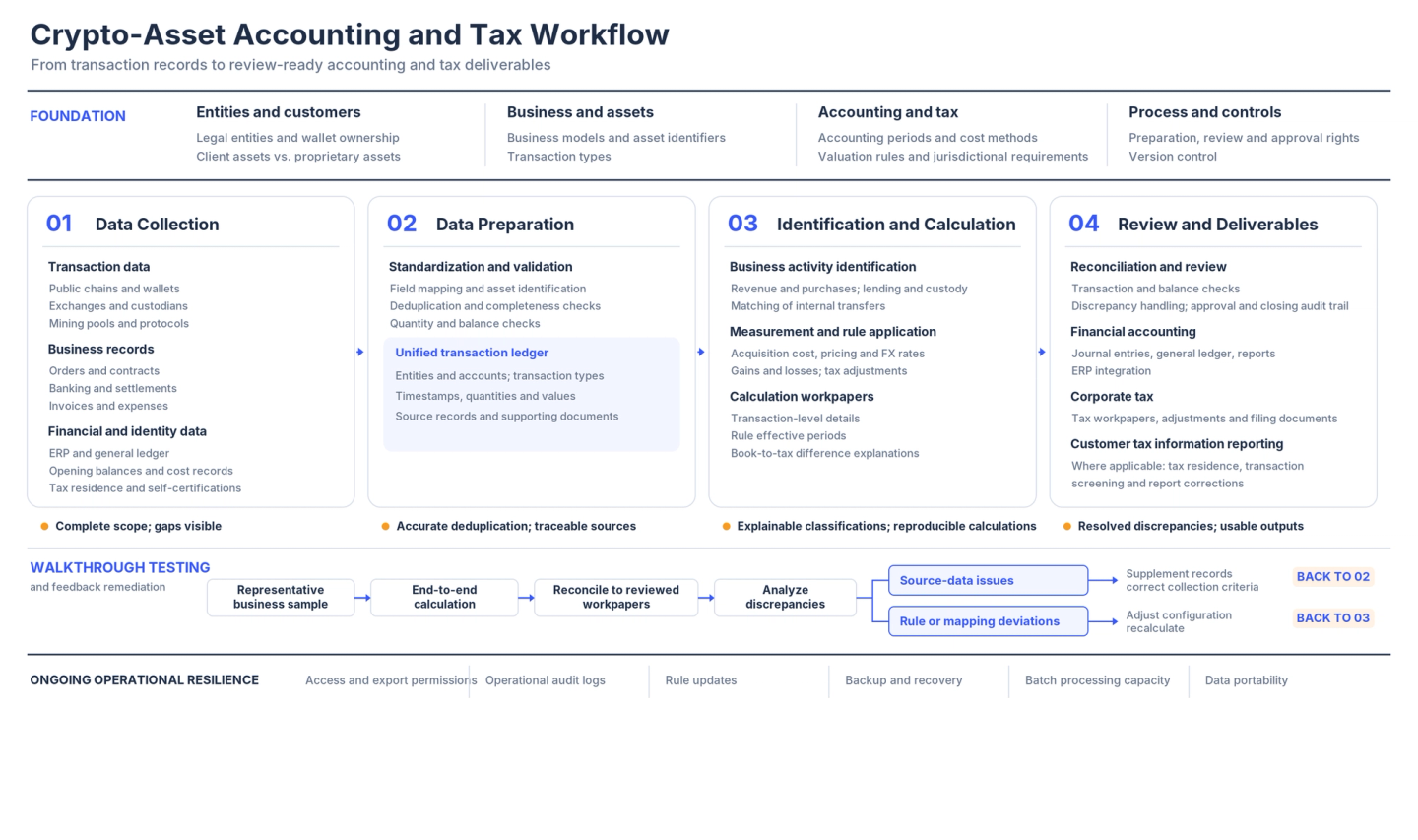
Figure. Accounting and Tax Processing and Validation Workflow for Crypto-Asset Businesses
Data ingestion should first be assessed for coverage and completeness. Businesses should check the available historical periods, transaction types and detail fields across the blockchains, trading platforms, custodians and business systems they actually use. After connecting to a platform, they should also confirm that records of spot trades, derivatives settlements, fees and fund transfers are complete. On-chain data should identify the relevant network and contract address. For sources that cannot be connected directly, the tool should provide a standardized import method and retain source identifiers.
This stage can be tested by comparing source data with the imported results for the same period. Checks should cover transaction counts, asset quantities and opening and closing balances, as well as whether failed records are visible, missing periods can be retrieved and repeated imports create duplicate entries. Businesses should also record the staff time required to consolidate the data.
Business activity identification turns raw data into explainable economic events. The tool should use account ownership, counterparties and business documentation to distinguish sales receipts, asset purchases and sales, lending, client funds and internal transfers. A cross-chain transaction or smart-contract interaction may generate multiple on-chain records for a single business activity. The system should preserve the relationships between those records and account separately for principal, yield and fees. Businesses should focus on their high-frequency activities and transaction types most likely to be misclassified.
For example, a company may transfer the same batch of assets from a revenue wallet to an aggregation wallet and then to an exchange for sale. The tool should maintain the asset history through transfers where ownership does not change, and calculate the related gain or loss when the assets are sold. Transfers between different entities within a group should record each entity and the nature of the intercompany transaction. During a trial, businesses can select manually confirmed samples to review the classification results, identification basis and outstanding items. Reasons for manually corrected classifications should also be retained to prevent the same transactions from being misclassified on the next import.
Measurement and calculation should be reproducible at the individual transaction level. Businesses should check price sources, valuation timestamps, time zones, exchange rates and fee treatments, confirming that different data sources use consistent conventions. When quotations or cost records are missing, the system should identify the gaps and their impact rather than treating missing values as zero. Where tokens are received and then transferred in batches or partially sold, the system should continuously track the quantity acquired, cost allocation, disposal proceeds and remaining holdings.
For validation, businesses can select samples involving multiple acquisitions, internal transfers and partial disposals, calculate them independently using an approved applicable method, and compare the results with the system output and detailed workpapers. Where multiple cost-basis methods are available, the team should confirm that the selected method applies to the relevant entity and jurisdiction. For items where accounting and tax treatments differ, book values, tax bases and supporting adjustment rationale should be retained separately. The effective period of each rule change should also be specified so that historical results can be reproduced using the treatment applied at the time.
Multi-entity management should be integrated throughout identification and calculation. Each transaction should be attributed to a specific legal entity, with separate books, applicable rules and accounting periods maintained for each entity. Group-level summaries should retain drill-down paths to the underlying records. Businesses can reconcile a set of related-party transactions between the relevant entities to check whether the tool distinguishes internal management reporting, consolidation eliminations and each entity’s separate filing, preventing group-level summaries from obscuring discrepancies at individual entities.
Reconciliation and review determine whether calculated results can be used for closing and filing. The tool should reconcile transaction details, account balances and financial ledgers, identifying unmatched records and explaining discrepancies. Matching closing balances may still conceal classification or period errors, so transaction-level checks are also necessary. For refunds, reversals, fee deductions and receipts recorded across reporting periods, the system should show how each discrepancy arose, who handled it and which records were affected by the resolution.
Businesses can retain a duplicate import, a missing record and a cross-period item in their test data to see whether the tool can identify each issue and whether corrections update the relevant workpapers. Review workflows should also distinguish preparation, review and approval permissions, and record what was changed and why. Adjustments to periods that have already been closed should follow a controlled process and retain version history, making differences between earlier and revised results explainable.
Output capabilities should be assessed against the needs of specific users. Finance teams need journal entries and supporting details that can be posted to the general ledger; tax teams need tax calculation workpapers and filing information; auditors need original evidence supporting calculations and judgments. Businesses should select a reported amount and trace it through the calculation rules, transaction records and supporting attachments. They should then check that, after data is imported into the existing ERP, the legal entity, account, currency and accounting period are correct, and that supplementary or repeated uploads do not create duplicate postings.
Businesses with customer tax information reporting obligations should separately validate their due diligence and reporting workflows. Under frameworks such as CARF, the tool should support the management of tax residence, self-certifications and tax identification number (TIN) information; screen users and transactions under applicable rules; and produce classified and aggregated results. Businesses should check how missing information, changes in identity details and report corrections are handled, and whether output files pass the relevant format validation. The scope of support for report generation, actual submission and acknowledgement management should also be confirmed before procurement.
Security and operational continuity are relevant throughout the process. Businesses should verify permission boundaries for data access, exports and rule changes, and clarify the scope of API credentials, data storage locations, and backup and recovery arrangements. Businesses with high transaction volumes should test ingestion, calculations and reruns using data volumes close to peak operating levels. They should also confirm that transactions, rules, workpapers and operation logs can be fully exported when the service ends, preserving continuity in accounting and record retention.
Businesses should also assess how rule configurations are maintained. When new wallets, assets or business activity types are added, it should be clear which fields authorized personnel can adjust and which changes require vendor development. For batch changes, the system should allow users to preview the impact before approval and execution, and retain rollback or restoration records. This helps determine whether the tool can continue to support the business after its initial launch as operations evolve, and what additional costs new requirements may bring.
The final assessment should focus on deliverables that can be reviewed and verified: whether data discrepancies can be explained, calculations reproduced, outstanding items assigned to responsible owners, and reports traced to source records. Businesses can set acceptance criteria according to business importance and transaction value, focusing on batch-processing efficiency for high-frequency activities and on the rationale and depth of review for material or unusual transactions. The tool’s suitability can then be assessed alongside implementation costs.
4. How Does FinTax Connect Crypto-Asset Accounting, Tax Information Reporting and Advisory Services?
To support businesses from transaction records through to accounting and tax deliverables, FinTax provides products and services for financial accounting, tax information reporting and professional advisory. Businesses can combine these services according to their existing systems and business scope, connecting data processing, rule execution and professional judgment within coordinated workflows.
FinTax Suite supports day-to-day crypto-asset accounting by consolidating data from on-chain sources, exchanges, custodians, banks and mining pools. It cleans and standardizes the data, maps it to the chart of accounts and generates accounting records. The suite provides cost-basis and gain/loss calculations, reconciliation, accounts receivable and payable, and reporting capabilities, while preserving traceability from source transactions to journal entries. Businesses with an existing ERP can use integrations to connect vouchers and account data, bringing crypto-asset details into their established financial systems.
For institutions with customer tax information reporting obligations, FinTax Tax Solution supports reporting workflows under frameworks including CARF, DAC8 and US Form 1099-DA. It organizes processes around customer tax identity, transaction classification, determination of reporting obligations and preparation of reporting files. The platform supports task management by legal entity and jurisdiction, flags missing information, enables review of transaction details and generates report files, allowing teams to trace the relevant data and processing status from each task.
FinTax Consulting provides further support for cross-border structures, transfer pricing, ongoing tax compliance and inquiries from tax authorities. It helps establish the basis for tax treatment in light of the substance of a business’s operations and works alongside software implementation to put that treatment into practice. For businesses operating through multiple entities and markets, advisory services and system implementation work together to clarify local obligations, data requirements and deliverables, reducing gaps between business judgments and technical configurations.
5. Conclusion: Validate the Suitability of Crypto Tax Tools Against Real Business Activities
Businesses should select crypto tax and accounting tools based on their own activities and gaps in existing workflows. Real transaction samples should be used to test whether data is complete, discrepancies can be explained, calculations can be reproduced and reports can be traced to source records. Based on these results, businesses can determine the appropriate product and delivery scope by considering transaction materiality, processing efficiency, implementation effort and ongoing maintenance costs.
Frequently Asked Questions
1. Which businesses need crypto tax tools, and how should they determine the scope of their needs?
Businesses that directly receive or make payments in crypto-assets, hold crypto-assets for treasury management, or conduct trading, custody or mining activities may have related needs. The specific scope should be assessed based on transaction complexity, the number of legal entities and the capabilities of existing systems. For businesses that use a service provider to convert crypto-assets into fiat currency immediately upon receipt, the need is generally more focused on settlement reconciliation.
2. Which core capabilities should businesses test when evaluating a crypto tax tool?
Key capabilities include multi-source data ingestion, transaction classification, cost-basis and gain/loss calculations, multi-entity accounting, reconciliation and review, and accounting and tax outputs. Testing should use real transactions to check data completeness, clarity of the basis for treatment and reproducibility of results, and confirm that permission management and operation logs support internal controls.
3. How can a crypto tax tool integrate with an existing ERP and prevent missing or duplicate entries?
A dedicated tool can handle the collection, identification and detailed accounting of crypto transactions, then transfer journal entries and related data into the existing ERP through an interface or standardized files. During implementation, the mappings for legal entities, accounts, currencies and accounting periods should be clearly defined, and results should be reconciled before and after transfer to prevent omissions or duplicate postings.
4. What is the difference between calculating gains and losses on a company’s crypto-assets and CARF customer tax information reporting?
Gain and loss calculations focus on the company’s own asset acquisition costs, disposal proceeds and related income. CARF reporting focuses on the tax identities of customers of in-scope service providers and transaction information within the prescribed reporting scope. The two processes have different data and workflow requirements. Businesses should determine their respective obligations separately before assessing the functionality they need.
Send this FinTax note to your team.
Talk with our team
Book a call