

1 Introduction
On November 27, 2025, a high-profile event was held in Hong Kong. Justin Sun, the founder of TRON, attended the "Truth Revealed, Justice Served—Media Briefing on the Progress of Global Judicial Pursuit of TUSD Reserve Assets." During the briefing, he disclosed key facts and preliminary results regarding the illegal seizure and misappropriation of TUSD reserve assets, which has drawn significant attention from the blockchain industry. It is reported that on October 17, the Dubai International Financial Centre Court (hereinafter referred to as the DIFC Court) issued an indefinite worldwide assets freezing order against the Dubai trade finance company Aria Commodities DMCC. The court pointed out that the case involves "serious matters requiring trial," including forged authorizations, breaches of fiduciary duty, illegal transfer of reserves, and cross-border money laundering. All involved individuals and entities are required to fully disclose the flow of funds, or they will face severe legal consequences.
The high-profile TUSD $456 million reserve misappropriation case—a capital seizure involving multiple jurisdictions including Hong Kong, Dubai, and the Cayman Islands—has recently seen major progress. However, judicial proceedings are still ongoing, and recovering the funds remains a challenge. This case has exposed undeniable loopholes in crypto asset custody and regulation. We can't help but ask: after this incident, how can we trust crypto trusts?
2 The TUSD Story: How $456 Million in Trust Assets Vanished
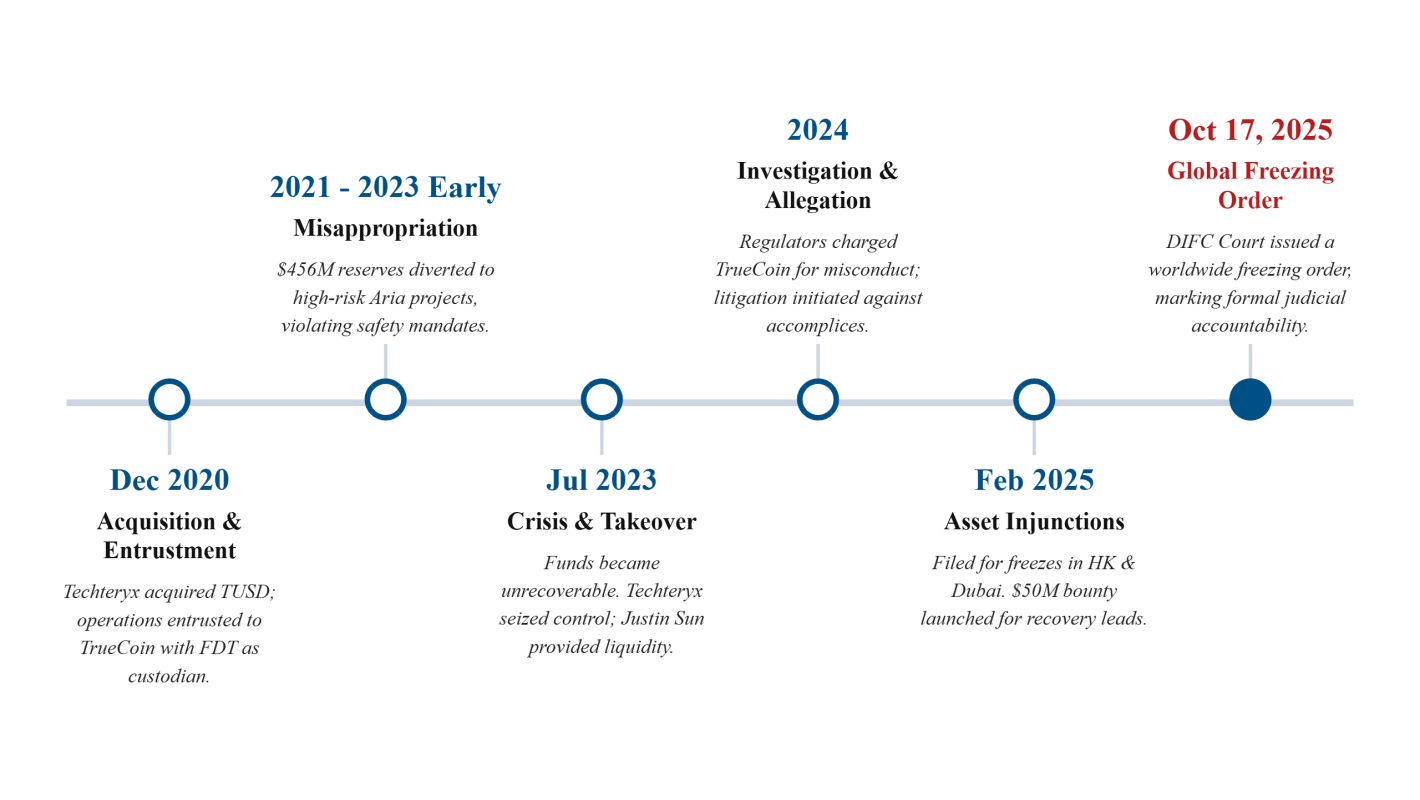
In late 2020, Techteryx, an Asian consortium, acquired the operating rights of the TUSD stablecoin from TrueCoin LLC. To ensure a smooth transition, Techteryx entrusted the original operator, TrueCoin, to continue managing the TUSD fiat reserves. TrueCoin recommended an offshore fund called Aria Commodities Finance Fund (ACFF) (registered in the Cayman Islands) to Techteryx as the primary investment channel.
However, TrueCoin, acting as the trustee, teamed up with the Hong Kong trust institution First Digital Trust (FDT) to abuse their management authority. Between 2021 and early 2023, Vincent Chok, the CEO of FDT, directly approved the secret transfer of up to $456 million in fiat reserves to a private trading company in Dubai, Aria Commodities DMCC, across six installments. This Dubai company is reportedly fully owned by the wife of the aforementioned ACFF fund's investment manager, creating a clear conflict of interest with the original investment target. To hide the illegal source of the funds, the involved parties also forged fund subscription documents, packaging these unauthorized reserves as "related loans" of the ACFF fund.
Once the money reached Dubai, Aria Commodities DMCC poured it into high-risk or unfinished projects with zero liquidity, including asphalt manufacturing facilities in the Middle East and coal mining rights in Africa. This effectively hollowed out TUSD’s fiat reserve assets. During 2023, Techteryx began to notice unusual movements in the reserves. They took over operations and appointed an independent professional team to conduct a full investigation into FDT, completely exposing the "black box" operations.
In January 2024, the crisis fully exploded. The price of TUSD severely depegged, and it faced the risk of chain liquidations involving billions of dollars. At this "life or death" moment, Justin Sun provided a loan of approximately $500 million to Techteryx using his personal funds. This helped the TUSD project team get through the hard times, successfully stabilized the TUSD price, and prevented the DeFi ecosystem from suffering a massive blow.
Subsequently, with the support of Justin Sun, the TUSD project team launched a "global asset preservation" legal war. In the Hong Kong lawsuit, FDT was accused of breaching the trust deed and faced claims for damages. In the Dubai lawsuit, Techteryx targeted the final recipient of the funds, Aria Commodities DMCC, asking the court to confirm that the money legally still belongs to Techteryx. In September 2024, the U.S. SEC publicly categorized TrueCoin’s actions as fraud. According to the latest news on October 17, 2025, the DIFC Court made a breakthrough ruling, issuing an indefinite worldwide assets freezing order to freeze $456 million in global assets belonging to Aria Commodities DMCC and its affiliates.
Figure 1: Key Timeline of the TUSD Reserve Misappropriation Case
3 TUSD Case Analysis: Why Did the Massive Reserves Leak Out
3.1 The Trust Structure of TUSD Reserves
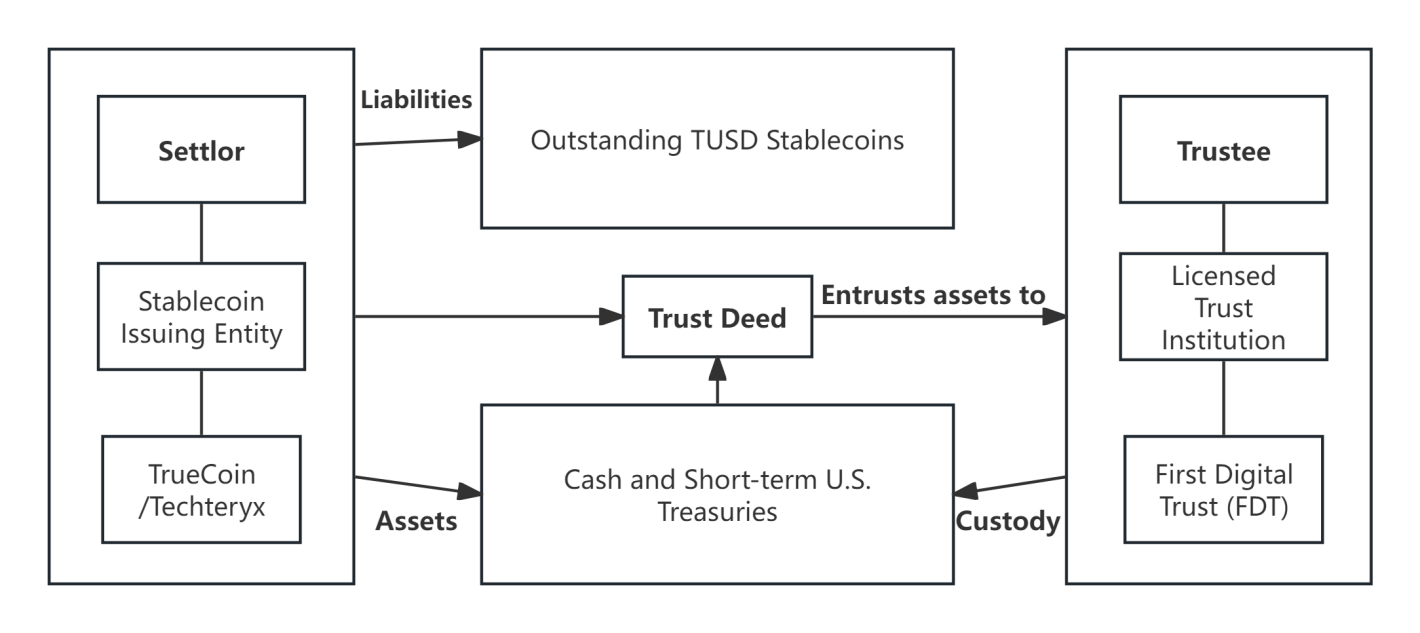
The TUSD reserve misappropriation case is a classic example of centralized risk, directly exposing the fragility of traditional financial trust mechanisms in managing stablecoin reserves. To understand how the money was illegally moved, we first need to look at the trust structure TUSD used. For stablecoins like TUSD (TrueUSD), the circulating supply and reserve assets must maintain a strict "1:1" peg. These reserves must be high-liquidity assets to ensure users can redeem them at any time. The stablecoin issuer (the Settlor) entrusts the reserves to a trust institution (the Trustee) for management. The core responsibility of the trustee is to act as a gatekeeper, safely custodying the assets and making low-risk investments as agreed. This structure bases asset security entirely on the trust placed in the trustee.
Figure 2: The Trust Structure of TUSD
3.2 Root Causes of the Fund Outflow
This misappropriation wasn't just a random mistake by one person; it was the result of multiple factors stacking up. These include the project team's lack of governance and supervision, illegal operations by the trust company and related parties, and the inherent structural fragility of traditional trusts.
From the perspective of project governance, Techteryx failed to properly choose and monitor the reserve operators and trustees. After Techteryx bought the TUSD project from TrueCoin, the operating rights actually stayed with TrueCoin. Later, TrueCoin conspired with FDT and other entities to secretly transfer huge reserves in batches to the private Dubai company Aria Commodities DMCC through a series of fraudulent transactions. Looking at ongoing supervision, the project lacked transparent disclosure and independent audits. Even though stablecoins are supposed to keep a 1:1 ratio between reserves and circulation, in this case, FDT used various tricks between 2021 and early 2023 to dump part of the reserves into high-risk, low-liquidity areas like mining, shipping, and manufacturing, instead of safe assets like cash or high-liquidity treasury bonds. It wasn't until Techteryx noticed that FDT could neither pay the agreed annual interest nor respond to redemption requests that they realized something was wrong. In July 2023, Techteryx officially took over all TUSD operations from TrueCoin and started a full investigation into FDT with an independent professional team.
From a systemic level, the cost of "trust" in a trust is too high because it tests human nature. The court documents from this TUSD case prove just how fragile the trust mechanism can be. According to the allegations, FDT and its associates were involved in "forged authorizations" and "breach of fiduciary duty," using reserve funds for high-risk investments without proper disclosure or investor consent. As the "gatekeeper" of the funds, Vincent Chok, the CEO of the Hong Kong trust FDT, used his status as trustee to not only approve the illegal transfer of $456 million to the private Dubai company but also pocketed over $15.5 million in secret illegal kickbacks. The involved parties then tried to cover their tracks by backdating fund subscription documents to make the stolen money look like "related loans," which is textbook fraud. The court's judgment explicitly stated that the involved individuals "were fully aware of and jointly participated in the fraudulent methods and harmful acts." This incident vividly shows that in traditional trust relationships involving human intermediaries, the moral risk of centralized managers (trustees) is extremely high. Once a trustee betrays their duty, the consequences for the entrusted assets are disastrous. It perfectly illustrates how traditional trust structures are built on the hope that people will be honest, but technical or rule-based enforcement is limited.
4 FinTax Commentary
The TUSD incident wasn't a failure of technology, but a structural hidden danger caused by concentrating too much trust in a single institution. For Web3 Participants and individuals looking to operate or invest safely in crypto assets long-term, compliance design isn't an "extra cost"—it's a necessary preparation to lower systemic risk. Truly effective compliance isn't just about finding a "trustworthy" custodian; it’s about setting up risk isolation mechanisms beforehand and following up with constant supervision.
First, it is crucial to clearly distinguish between the legal ownership and beneficial ownership of assets. You must ensure that reserve assets are legally independent from the project team and the custody institution itself. This way, the assets won't be dragged onto their balance sheets in the event of bankruptcy, liquidation, or internal violations.
Second, for moving funds and making key decisions, multi-sig arrangements and other multi-party check-and-balance mechanisms should be introduced. This prevents any single entity from moving core assets without oversight.
Finally, when choosing a jurisdiction, you should prioritize regions with high enforcement efficiency and clear regulatory boundaries. Through professional legal and tax design, you can ensure that cross-border fund flows, instruction paths, and audit chains have clear, traceable legal evidence. This prevents losing the ability to hold people accountable or seek remedies because the structure was too complex.
Differences in cross-border regulatory views, frequent tax rule changes, and the unique nature of crypto assets mean that a "one-size-fits-all" solution probably won't handle both compliance and long-term stability. Therefore, when growing a crypto asset business, it’s a good idea to seek support from third parties with relevant experience to lower future compliance and tax risks.

FinTax offers crypto accounting suite, tax calculator and professional tax consulting services.